Pull-out trash cans for a 12-inch cabinet
Most pull-out kits need a 15-inch opening or more, which rules them out of a 12-inch cabinet entirely. Two units genuinely fit. Here is how to confirm yours before you spend anything.
By Ryder M. · Last reviewed October 10, 2026
Lid & Liner is reader-supported. If you buy through a link on this page we may earn a commission at no extra cost to you. It never changes which product we rank first — how we pick and how we make money.
The short answer
A 12-inch base cabinet has an opening of roughly 10.5 inches, and the only mainstream pull-out units that fit it are the simplehuman under-counter cans - the 35L dual states a minimum opening of 10 inches wide, and the 30L single sits on the same frame. Almost every Rev-A-Shelf double needs 15 inches or more: the 4WCSC-1835DM-2 publishes a minimum of 15 inches wide by 20-5/8 inches high, and the Value Line double is built for a standard 18-inch cabinet. If neither simplehuman unit works for you, the honest answer is a 6.5-inch-wide freestanding slim can rather than a pull-out.
Nothing about this is obvious from the listings, because cabinet units are advertised against nominal cabinet sizes while the thing that actually has to fit is the opening. The two numbers differ by about an inch and a half, and that inch and a half is exactly the margin this decision lives in.
Measure the opening, not the cabinet
A "12-inch cabinet" describes the carcass width. The frame, the stiles and the door hinges all eat into that, and what a pull-out slides through is what is left. Do this before you look at a single product.
- Open the door fully and measure the narrowest point of the opening, left to right, at the front. On a face-frame cabinet that is between the stiles; on a frameless one it is between the side panels. Expect roughly 10.5 inches from a 12-inch cabinet.
- Measure the clear height, from the cabinet floor to the underside of the rail at the top of the opening - not to the countertop. A bottom-mount unit needs this figure, and it is the second most common reason a kit does not fit.
- Measure the depth to the back wall, past the plumbing. On a sink cabinet the trap is the obstruction, and it sits exactly where the back bucket wants to go.
- Check the hinge intrusion. A door hinge that protrudes into the opening when the door is open will foul a bucket on the way out, even when the stated width fits.
- Write down all four numbers before you shop. Any unit whose published minimum opening exceeds any one of them is out, regardless of how it is marketed.
We wrote the full measuring routine up separately, including the depth and trap checks, in how to measure a cabinet for a pull-out can.
What fits a 10.5-inch opening, and what does not
| Unit | Published minimum opening | 12-inch cabinet? |
|---|---|---|
| simplehuman 35L Dual Under-Counter | 20" H x 10" W x 20" D | Yes, on width - check your depth |
| simplehuman 30L Single Under-Counter | Same frame; single bucket | Yes, on width - check your depth |
| Rev-A-Shelf 4WCSC-1835DM-2 | 15" W x 20-5/8" H | No |
| Rev-A-Shelf Value Line 18-inch double | Built for a standard 18-inch cabinet | No |
| Rev-A-Shelf 53WC door-mount double | Built for an 18-inch cabinet | No |
The pattern is simple: double 35-quart kits are wide because two 35-quart buckets side by side are wide. Physics, not marketing. The simplehuman units fit because they carry two smaller buckets - 35 liters total across both, against 70 quarts for a Rev-A-Shelf double - and because the frame is thinner.
That capacity difference is the real trade, and it is worth being clear-eyed about it: a 12-inch cabinet pull-out holds roughly 9 gallons across two compartments. That is a small kitchen can split in half. If your household fills a 13-gallon can every day, a 12-inch cabinet is not going to be your main trash solution whatever you install in it.
The two units that actually fit: the dual-compartment 35L with its published 10-inch minimum width, and the single-bucket 30L on the same frame when recycling goes elsewhere.
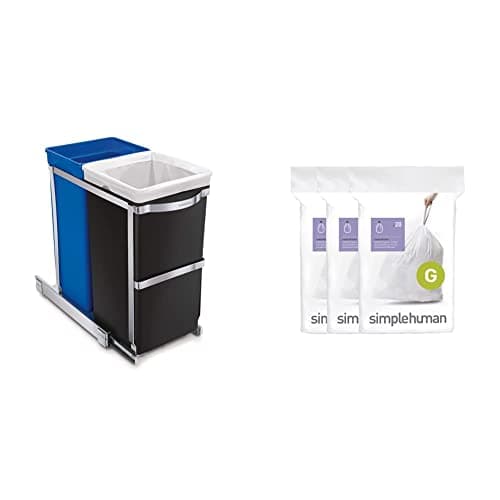
Best pull-out overall
simplehuman 35L Dual Compartment Under-Counter Pull-Out Can
The pull-out that is easiest to install and hardest to break: an all-steel frame on commercial ball-bearing tracks that arrive as one pre-assembled piece.
Price as of October 16, 2026. #ad How we make money
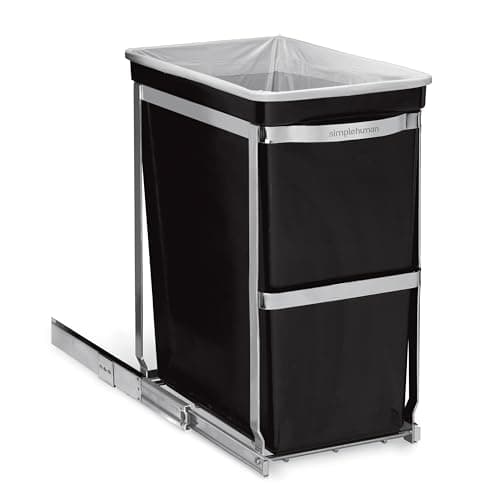
Best single-bucket pull-out
simplehuman 30L Under-Counter Pull-Out Can
The single-bucket version, for a household that recycles elsewhere and wants all the cabinet volume for trash.
Price as of October 16, 2026. #ad How we make money
If nothing fits, stop trying to make a pull-out work
There is a point where the right answer is a different product rather than a smaller version of the one you wanted. A 12-inch cabinet that fails on depth or height is that point, and the alternative is genuinely good: a purpose-built slim can that stands in the gap beside the cabinet instead of inside it.
- A 6.5-inch-wide slot-filler goes where a round bin wastes everything - beside a fridge, at the end of a cabinet run, between a sink unit and a wall. That is narrower than the cabinet you were trying to use.
- No drilling, no slides, no alignment. Nothing to bind in six months and nothing to undo when you move out, which matters in a rental. Renter-friendly under-sink options.
- You keep the cabinet. A 12-inch cabinet is a genuinely useful place for cleaning supplies, trays or a step stool, and a pull-out can eats all of it.
- It costs a fraction of a kit plus hardware. And the hardware is the expensive half of a pull-out.
The honest comparison of both approaches is in pull-out trash can pros and cons, and the full field of narrow freestanding cans is in the best slim and narrow trash cans.
The slot-filler answer: two cans 6.5 inches wide, one with a lid and a pedal, one open-topped for a bathroom.
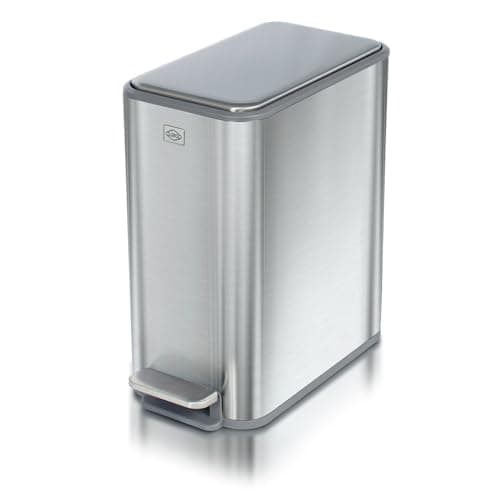
Best for a narrow gap
Clorox Slim 2.6 Gallon Step Trash Can
A seven-inch-wide steel step can with a soft-close lid and a liftable inner bucket, for the gap beside a desk or a vanity.
$34.99 · 14% off · Price as of October 16, 2026. #ad How we make money
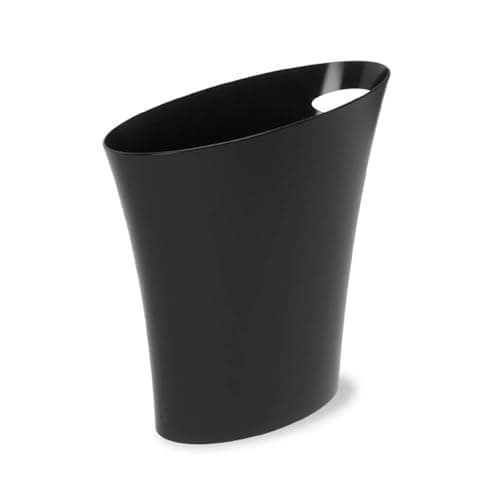
Best narrow small can
Umbra Skinny Trash Can, 2 Gallon
Six and a half inches wide, which is the number that matters when the only space is between the toilet and the wall.
Three things that make a narrow pull-out fail later
Depth, almost always
The simplehuman 35L states a 20-inch minimum depth and plenty of older sink cabinets fail that because of the trap. A unit that fits on width and not on depth will go in and then foul every time you pull it. Measure past the plumbing to the back wall.
A frame that flexes
Narrow units carry their load on a narrower base, so frame stiffness matters more here than in an 18-inch cabinet. A steel frame holds alignment where a wire basket gradually racks and puts the slides out of true. What to look for in the hardware.
Liner overhang in a small bucket
A 30-liter bucket with a 13-gallon bag in it is mostly bag. The overhang gets caught between the bucket and the frame, the bag slips, and residue ends up in the cabinet. Use an 8 to 10 gallon liner, or the coded liner the can is built for - simplehuman codes these G and D. Fitted liners versus ordinary bags.
Common questions
Will a pull-out trash can fit a 12 inch cabinet?
Only a narrow one. A 12-inch cabinet gives you about a 10.5-inch opening, and the simplehuman under-counter units state a 10-inch minimum width. Most Rev-A-Shelf doubles need 15 inches or more and will not fit.
What size opening does a 12 inch cabinet have?
Roughly 10.5 inches at the narrowest point, once the frame, stiles and hinges are accounted for. Measure it rather than assuming - frameless cabinets give more than face-frame ones.
How many gallons fits in a 12 inch cabinet pull-out?
About 9 gallons total, usually split across two buckets of roughly 4.5 gallons each. That is half a standard kitchen can, so it suits a household that recycles heavily rather than one filling a 13-gallon bag daily.
What is the narrowest pull-out trash can?
Among mainstream units, the simplehuman under-counter cans at a stated 10-inch minimum opening. Below that there is no pull-out worth installing, and a 6.5-inch-wide freestanding slim can is the better answer.
Can I put a pull-out trash can in a sink cabinet?
Often, but depth is the constraint rather than width - the trap sits where the back bucket wants to travel. Measure to the back wall past the plumbing, and check the stated minimum depth on the unit.
Is a slim freestanding can as good as a pull-out?
In a narrow space, frequently better. It is 6.5 inches wide against a 10.5-inch opening, needs no drilling, cannot go out of alignment, and leaves you the cabinet.
Sources
Every specification on this page traces to one of these, checked at the time of writing. Where a manufacturer does not publish a figure, the page says so rather than estimating it.
- simplehuman - 35L Dual Compartment Under Counter Pull-Out Can (minimum opening 20in H x 10in W x 20in D, tracks)
- CabinetParts - Rev-A-Shelf 4WCSC-1835DM-2 (minimum opening 15in W x 20-5/8in H, Blum Blumotion slides)
- Rev-A-Shelf - RV series pull-out waste containers (cabinet sizes)
- Clorox - Slim 2.6 Gallon Step Trash Can (13.3in x 7in x 14.2in)
Read next
- Pull-Out & Slim CansUnder-sink pull-outs, narrow cans, cabinet hardware, and how to measure first.
- How to measure a cabinet for a pull-out canFive measurements with real published minimums to check them against.
- The best under-sink pull-out trash cansSix pull-outs compared on slides, frames and the openings they actually need.
- The best slim and narrow trash cansSix narrow cans that keep capacity by going deep rather than wide.
- How to install a pull-out trash canBottom mount versus door mount, the four measurements to take first, and the install in eight steps.
The author
Ryder M.
Owner and editor of Lid & Liner, published by Magoo Media Group. He started the site after getting tired of the same problem everyone has: every “best trash can” article covers ten products and none of them tells you whether a 13-gallon bag actually fits a 13-gallon can. Lid & Liner covers one category and tries to cover it completely.
Last reviewed October 10, 2026. Spotted an error? Tell us and we will correct it and note the correction.