Pull-out trash can pros and cons
A cabinet pull-out buys you back a square foot of floor and hides the can completely. It costs you cabinet storage, a harder clean, and a capacity ceiling most people do not expect. Here is the trade in full.
By Ryder M. · Last reviewed October 6, 2026
Lid & Liner is reader-supported. If you buy through a link on this page we may earn a commission at no extra cost to you. It never changes which product we rank first — how we pick and how we make money.
The short answer
A pull-out is the right answer if your kitchen is short of floor space and you have a cabinet you can give up; it is the wrong answer if you generate a lot of waste or rent the kitchen. The real gain is that the can disappears, including visually, and that one square foot of floor comes back. The real costs are a lost cabinet, a capacity ceiling around 9 to 10 gallons per bucket, and a unit that is harder to clean than a can you can carry to the sink.
That is the honest summary, and it is worth stating plainly because the category is usually sold on the aesthetic alone. The aesthetic is genuine. So are the trade-offs.
The case for a pull-out
- It returns floor space. A 13-gallon freestanding can occupies roughly a square foot plus clearance for the lid. In a small kitchen that is the difference between a usable aisle and a pinch point.
- The lid problem disappears. There is no lid to bang, no damper to wear out, and no pedal linkage to fail - the cabinet door is the lid. That removes the most common failure point in the whole category.
- Odor is contained twice. Waste sits inside a bucket inside a closed cabinet. Two barriers is measurably better than one, and it is why pull-outs are quietly good at the thing people buy filters for.
- Pets and toddlers cannot get in. A closed cabinet door, optionally with a child latch, is a far better barrier than any locking lid. Dog-proof cans exist because this is hard to achieve any other way.
- Sorting gets easier, not harder. Most units are twin-bucket, so landfill and recycling live behind one door and get used at the same moment.
- It is quiet. No spring, no motor, no mechanism - just a drawer slide.
The case against
You lose a cabinet, and it is usually the useful one
The cabinet a pull-out wants is the one next to the sink or the dishwasher - the same one that currently holds cleaning supplies, and the only one with easy plumbing access. Giving it up is the cost nobody prices in, and in a small kitchen it may be a worse loss than the floor space it recovers.
Capacity is capped by the cabinet
A standard 18-inch cabinet takes two 35-quart buckets, which is about 8.75 gallons each. A single-bucket unit in the same cabinet runs around 8 to 9 gallons. If your household currently fills a 13-gallon can every day and a half, a pull-out means more frequent bag changes, not fewer.
Cleaning is harder
When a freestanding can gets unpleasant you carry it outside and hose it. A pull-out means lifting buckets out, cleaning the cabinet floor on your knees, and dealing with whatever has run down the inside of the cabinet side. Spills are also invisible until they are smells.
Installation is real work, or a real cost
Bottom-mount slides need the cabinet floor to be flat, square and strong enough. Face-frame cabinets often need spacers. The unit has to clear the door hinges, the door handle, the plumbing and the garbage disposal. How to measure a cabinet for a pull-out is the step that decides whether this goes well.
It is not renter-friendly in standard form
Most units screw into the cabinet. There are freestanding frames and shelf-hung buckets that leave no holes, and they are a genuine answer, but they are less rigid and hold less. Renter-friendly under-sink cans.
Two motions instead of one
A step can is one foot press. A pull-out is open the door, pull the frame, drop the waste, push, close - or on soft-close hardware, slightly less than that. It sounds trivial and it is the thing people adapt to within a week, but it is the reason some households end up with a pull-out full of recycling and a small bin on the counter for everything else.
Which households should buy one
| Household | Pull-out? | Why |
|---|---|---|
| Small kitchen, owner-occupied | Yes | Floor space is the binding constraint and you can modify the cabinet |
| Dog or toddler in the house | Yes | A closed door beats any locking lid |
| Open-plan kitchen you care about visually | Yes | The can disappears entirely |
| Family of four or more | Probably not | Capacity ceiling means more bag changes |
| Renter | Only the no-drill versions | Standard units screw into the cabinet |
| Kitchen with few cabinets | No | The cabinet you give up is worth more than the floor |
| Anyone who hates fiddly cleaning | No | Spills land inside a cabinet |
If the answer is yes, these are the three to look at - the pre-assembled twin-bucket unit, the standard bottom-mount kit stocked everywhere, and the single-bucket version for when all 30 liters needs to be trash.
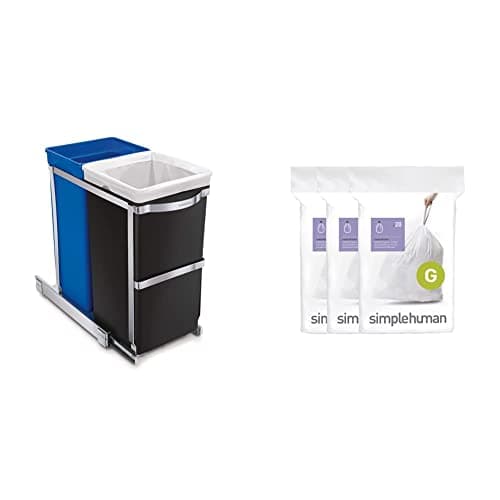
Best pull-out overall
simplehuman 35L Dual Compartment Under-Counter Pull-Out Can
The pull-out that is easiest to install and hardest to break: an all-steel frame on commercial ball-bearing tracks that arrive as one pre-assembled piece.
Price as of October 16, 2026. #ad How we make money
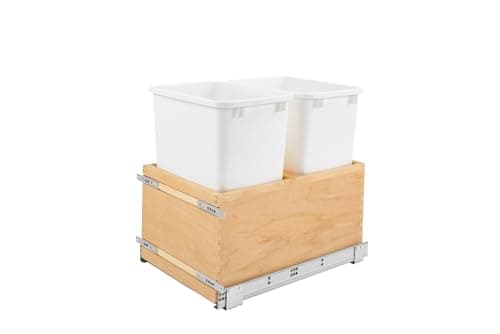
Best value double
Rev-A-Shelf Value Line Double Pull-Out for 18-Inch Cabinets, 35 Quart
The common-as-dirt RV-series kit: two 35-quart bins on a bottom-mount soft-close frame, stocked by every major retailer.
Price as of October 16, 2026. #ad How we make money
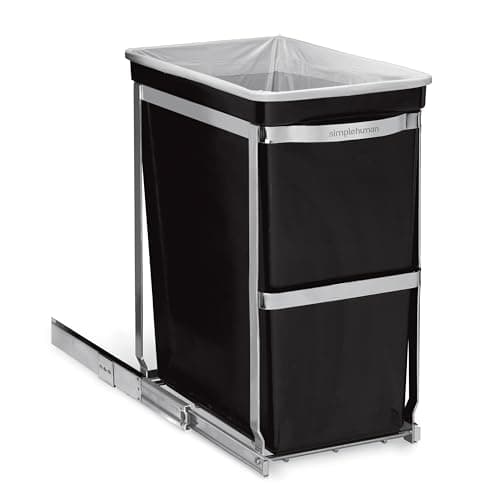
Best single-bucket pull-out
simplehuman 30L Under-Counter Pull-Out Can
The single-bucket version, for a household that recycles elsewhere and wants all the cabinet volume for trash.
Price as of October 16, 2026. #ad How we make money
If you are choosing between specific units rather than deciding in principle, the full comparison is in the best under-sink pull-out cans, and the hardware-only route - keep your buckets, buy the frame - is in cabinet pull-out hardware.
The middle option people miss
There is a third answer between a pull-out and a freestanding can: a slim freestanding can in the gap a pull-out would have cost you a cabinet to avoid. A narrow, deep can holds a full 11 to 12 gallons in about two-thirds the width of a conventional one, needs no installation, costs less than a mid-range pull-out, moves house with you, and goes to the sink to be washed.
It does not hide the can and it does not keep the dog out. But if your reason for wanting a pull-out is floor space rather than appearance, it solves the same problem for less money and no cabinetry. Slim and narrow cans, measured and apartment-sized picks.
Common questions
Are pull-out trash cans worth it?
In a small owner-occupied kitchen, yes - they return about a square foot of floor, hide the can, contain odor behind two barriers and keep pets out. In a large household or a rental they usually are not, because capacity is capped by the cabinet and most units need screws.
What are the disadvantages of a pull-out trash can?
You lose a cabinet, usually the one beside the sink; capacity is capped at roughly 8 to 10 gallons per bucket; cleaning spills inside a cabinet is harder than hosing a can outside; and installation needs accurate measurement and a flat cabinet floor.
How big is a pull-out trash can?
A standard 18-inch cabinet takes two 35-quart buckets, about 8.75 gallons each. Single-bucket units in the same opening run around 8 to 9 gallons. That is less than the 13-gallon can most kitchens currently use.
Do pull-out trash cans smell?
Less than a freestanding can, generally, because the waste sits inside a bucket inside a closed cabinet. The exception is spills that run down the cabinet side, which go unnoticed far longer than a spill beside a visible can.
Can you install a pull-out trash can in any cabinet?
No. The cabinet needs a flat, strong floor, enough clear width inside the face frame, and no plumbing or disposal in the way. Measure the opening rather than the cabinet front before buying anything.
What is better, a pull-out or a slim freestanding can?
If the goal is floor space, a slim can solves it for less money and no installation. If the goal is hiding the can, keeping a dog out, or sorting two streams behind one door, the pull-out is the one that actually does those things.
Sources
Every specification on this page traces to one of these, checked at the time of writing. Where a manufacturer does not publish a figure, the page says so rather than estimating it.
Read next
- Pull-Out & Slim CansUnder-sink pull-outs, narrow cans, cabinet hardware, and how to measure first.
- The best under-sink pull-out trash cansSix pull-outs compared on slides, frames and the openings they actually need.
- How to measure a cabinet for a pull-out canFive measurements with real published minimums to check them against.
- Renter-friendly under-sink trash cansFive no-drill approaches ranked, including the two not worth bothering with.
- The best cabinet pull-out hardwareHardware and spares, and how to tell which frame you already have.
- The best trash cans for apartmentsFive cans for apartment kitchens - narrow footprint, quiet lid, nothing that needs a drill.
The author
Ryder M.
Owner and editor of Lid & Liner, published by Magoo Media Group. He started the site after getting tired of the same problem everyone has: every “best trash can” article covers ten products and none of them tells you whether a 13-gallon bag actually fits a 13-gallon can. Lid & Liner covers one category and tries to cover it completely.
Last reviewed October 6, 2026. Spotted an error? Tell us and we will correct it and note the correction.