Ninestars 21 gallon XL automatic trash can review
Eighty liters is roughly one and a half ordinary kitchen cans, opened hands-free. That solves a real problem, and it creates two new ones nobody warns you about.
By Ryder M. · Last reviewed October 20, 2026
Lid & Liner is reader-supported. If you buy through a link on this page we may earn a commission at no extra cost to you. It never changes which product we rank first — how we pick and how we make money.
The verdict in one paragraph
Buy it if a 13-gallon can is full before the dinner dishes are done, and only then. The Ninestars 21 Gallon XL is an 80-liter rectangular stainless sensor can with a wide throat, a removable liner ring and a manual mode that holds the lid open - the standard Ninestars recipe scaled up by about half again. At this capacity it is unusually cheap for what it is, and it is one of the very few sensor cans sold at 80 liters at all. What you are accepting in exchange is a fixed-timer sensor, a body with a genuinely large floor footprint, and a bag problem that gets worse as the can gets bigger.
| # | Product | Best for | Price |
|---|---|---|---|
| 01 | 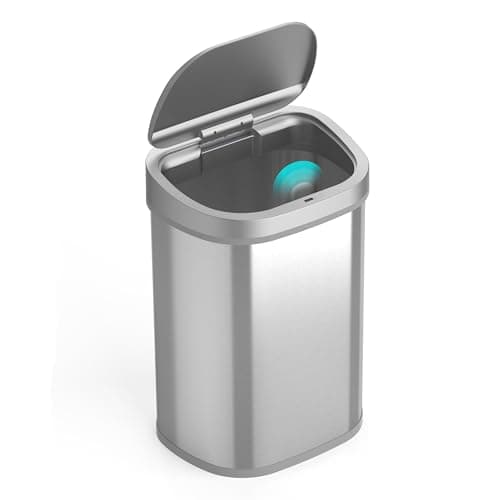 Ninestars 21 Gallon XL Automatic Touchless Trash Can (80 L)The biggest sensor can most households will consider: 80 liters, a wide opening, and a manual mode that locks the lid open. | Best XL sensor can | $89.99 · View on Amazon $99.99 · 10% off · Price as of October 20, 2026. #ad How we make money |
If you have not already decided that you want the capacity, start with the best Ninestars trash cans, which ranks this against the three smaller models in the line. This page is for the reader who has decided on 80 liters and wants to know what living with it is like.
What 80 liters actually buys you
Eighty liters is 21.1 US gallons. Against the standard tall kitchen can at 13 gallons, that is about 62 percent more volume - not double, which is worth saying because the jump feels bigger on paper than it is in the kitchen. In practical terms it is the difference between taking the bag out every evening and taking it out every second or third evening, for a household of four or five who cook from raw ingredients.
The capacity also changes what fits without being broken down. A flat pizza box, a gallon milk jug, a large takeout container and a cereal box all go in whole. That matters more than the volume number, because the real reason a kitchen can overflows is rarely that it is full of compressed waste; it is that somebody balanced a box on top of the rim and the lid would not close. A wide throat fixes that failure, and a sensor lid means nobody has to touch the can while holding the box.
Where 80 liters is the wrong answer is a household of one or two. Waste does not wait patiently for you to fill a bigger bag - it rots on the schedule it was always going to rot on. A large can used slowly is a bag of chicken trimmings sitting in a warm kitchen for four days, and no carbon filter in this price bracket will fix that. If your bags go out half empty today, the can you want is smaller, not bigger. What size trash can for a family of four runs that arithmetic properly.
The battery question, and why nobody agrees on the answer
This is the single most confusing thing about the model, and it is confusing because the manufacturer contradicts itself. Ninestars sells this can under the model code DZT-80-4. On its own product page for the DZT-80-4, Ninestars states the can takes 2 C alkaline batteries. On its own replacement-parts listing for CAP-4 - the battery cap for the DZT-80-4 and the WM-80-4 - Ninestars describes the part as the cap for a can that uses 3 D size batteries. Home Depot's listing for the same model code states 4 D batteries. Those are three different answers from three sources, one of which is the manufacturer disagreeing with itself.
We are not going to pick one and present it as fact. What we can tell you is the only reliable procedure: open the battery compartment on the underside of the lid before you buy any cells. The cell size is molded into the housing next to the contacts, and the count is obvious once the cap is off. It takes fifteen seconds and it is the only source that is definitely talking about the can in your kitchen.
What this does tell you about the brand is useful in itself. Ninestars is the budget sensor brand that is best about publishing battery figures - it is the only one in the bracket that commits to numbers at all - and even it cannot keep its own spec sheets aligned across a product line. Treat every published figure in this category as a starting point rather than a guarantee, and read touchless trash can batteries and power before you buy a multipack of the wrong cell.
- Check the compartment, not the listing. The cell size is molded next to the contacts.
- Buy alkaline, not rechargeable. Rechargeable cells sit at 1.2 V rather than 1.5 V, and a sensor board that is marginal at 1.5 V behaves erratically at 1.2 V - intermittent opening is the usual symptom.
- Change all of them together. Mixing a fresh cell with two tired ones is the commonest cause of a lid that opens but will not close.
- Use the power switch when you go away. The sensor draws current continuously while armed, and a can left watching an empty kitchen for a fortnight is a flat set of batteries for nothing.
The bag problem at this size
A 13-gallon can has a bag made for it in every supermarket in the country. An 80-liter can does not. This is the practical cost of going XL and it is the thing most reviews skip.
The can ships with a removable liner ring, which is the right answer to the problem: the ring clamps the bag mouth to the rim and the lid closes over it, so a bag that is too big in circumference is hidden rather than flapping. But a bag that is too short still drops into the can under load, and 80 liters of waste is a lot of load. In practice you want a liner rated somewhere around 20 to 30 gallons rather than a tall kitchen bag - Ninestars sells a 21-gallon drawstring liner for the model, and the generic equivalent is a 20-30 gallon commercial liner.
Two of our reference pages are directly relevant here and worth reading before you order a case of the wrong thing: 20 gallon trash can dimensions and what bags fit explains how a nominal gallon figure on a can and on a bag can describe two different objects, and why your trash bag doesn't fit is the general version of the same problem.
There is a weight consequence too. A full 80-liter bag of kitchen waste is heavy enough that a thin liner will split on the lift out - not at the bottom, but along the seam where you grip it. If you are going to run this can genuinely full, buy a heavier-gauge liner than you think you need. The extra cost per bag is trivial next to cleaning the floor once.
Living with the sensor
The lid is infrared and it closes on a fixed timer, which is the defining limitation of every can in this bracket. It does not detect that your hand is still there; it counts down and shuts. The expensive cans use an adaptive sensor that holds the lid open while something is in range, and that is genuinely the one feature worth paying up for - we argue it out in are touchless trash cans worth it.
Ninestars' answer is the manual mode, and on a can this size it matters more than on a small one. Press the manual button and the lid stays open until you press it again, which is what you want when you are clearing a fridge shelf or breaking down packaging. Use it. Fighting the timer is the single commonest reason people decide they dislike sensor cans, and the button that solves it is right there on the lid.
The other maintenance item is the sensor window. An infrared eye smeared with cooking grease reads as a permanent hand and the lid will sit open or cycle on its own. Wipe it when you wipe the body. If the lid is already misbehaving, touchless trash can keeps opening is the diagnostic order, and touchless lid not opening covers the opposite fault.
Where it sits on price, and what the parts path looks like
On Ninestars' own site this can carries a full retail price well into three figures; on Amazon it routinely sells a long way below that, in the same bracket as an ordinary mid-market 13-gallon step can. That gap is the whole commercial argument for the model - at Ninestars' list price there are better 80-liter answers, and at the street price there is essentially nothing else offering sensor operation at this capacity. Check the live price before you decide; this is a model where the number moves.
The parts story is better than the category average and worth knowing before you buy. Ninestars runs an actual replacement-parts store, and CAP-4 - the battery cap for this model and the WM-80-4 - is stocked there for about the price of a pack of batteries. That is not a trivial detail on a sensor can: a lost or cracked battery cap is one of the commonest ways these cans get thrown out, and most brands have no answer for it at all. We mapped the whole catalog in Ninestars trash can replacement parts, including which models have no official cap and what the warranty does and does not cover.
Who should not buy this can
- Households of one or two. You will not fill it in two days, and a slowly-filled large can is an odor problem. Buy 13 gallons or less.
- Anyone short on floor space. This is a large rectangular body and the lid needs clearance to swing. Measure the footprint and the height above the can before you order, because Ninestars does not publish usable dimensions for this model and we are not going to invent them.
- Anyone who hates the fixed timer. The capacity does not change the sensor behavior. If a lid that shuts on your hand would drive you mad, the fix is an adaptive sensor, not a bigger can - see the best touchless trash cans.
- Anyone who wants to use supermarket tall kitchen bags. They do not fit properly at 80 liters. If standard bags are non-negotiable, buy a 13-gallon can and empty it more often.
- Anyone buying for a garage or workshop. At this size a plain wheeled can is cheaper, tougher and does not need batteries. The best garage trash cans covers that properly.
What we would buy instead, depending on why you are here
If the attraction is hands-free and the capacity is incidental, the DZT-50-9 is the better-documented can in the line and the one with a published cycle figure behind it - our Ninestars DZT-50-9 review is the long version. If the attraction is capacity and hands-free is incidental, a 20-gallon step can costs less, has nothing electrical in it and takes the same liners; the best 20 gallon trash cans ranks those. And if you want hands-free at 80 liters with an adaptive sensor, that product does not really exist at a sane price today, which is the honest reason this can has the field largely to itself.
The can this page is about. Check the live price before you commit - the gap between list and street on this model is unusually wide.
Best XL sensor can
Ninestars 21 Gallon XL Automatic Touchless Trash Can (80 L)
The biggest sensor can most households will consider: 80 liters, a wide opening, and a manual mode that locks the lid open.
$99.99 · 10% off · Price as of October 20, 2026. #ad How we make money
Common questions
How many batteries does the Ninestars 21 gallon trash can take?
Ninestars gives two different answers: its DZT-80-4 product page says 2 C alkaline cells, and its own CAP-4 replacement-cap listing describes the can as using 3 D cells. Home Depot lists 4 D. Open the battery compartment under the lid and read the molding - that is the only reliable source.
What size trash bags fit a 21 gallon Ninestars can?
A liner in the 20-30 gallon class, not a standard 13-gallon tall kitchen bag. The removable liner ring hides excess circumference, but a bag that is too short will still drop into the can when it is loaded.
Is the Ninestars 21 gallon can the DZT-80-4?
Ninestars sells the 21.1-gallon rectangular sensor can under the model code DZT-80-4, and that is the code its own parts listings use. Retail listings for the can often omit the code entirely, so check the base or the box if you need it for a replacement part.
Does the lid stay open while you load it?
Only in manual mode. In sensor mode the lid closes on a fixed timer rather than holding while something is in range. Press the manual button for long jobs - that is what it is for.
Can you get replacement parts for it?
Yes for the battery cap: Ninestars stocks CAP-4 for the DZT-80-4 and WM-80-4 through its own parts store. The warranty itself covers only the electronic mechanism of the lid, and explicitly excludes battery caps, liner rings and the inner bucket.
Is 21 gallons too big for a kitchen?
For one or two people, yes - the bag sits too long before it is full and the can becomes an odor problem. For four or more who cook from raw ingredients, it is the size that stops a nightly bag change.
Sources
Every specification on this page traces to one of these, checked at the time of writing. Where a manufacturer does not publish a figure, the page says so rather than estimating it.
- Ninestars USA - Rectangular Motion Sensor Trash Can 21.1 Gallon (DZT-80-4) product page: capacity, material, liner ring, manual mode, stated battery
- Ninestars USA - CAP-4 replacement battery cap (fitment for DZT-80-4 and WM-80-4, stated battery)
- Ninestars USA - replacement parts catalog (what is stocked and for which models)
- Ninestars USA - warranty policy (what the lid warranty covers and excludes)
- Home Depot - NINESTARS 21 Gal. Auto-Open Infrared Trash Can DZT-80-4 (retail listing battery figure)
Read next
- The best Ninestars trash cansFour Ninestars sensor cans compared on published battery life, body shape and the usable volume the box does not print.
- Ninestars trash can replacement partsWhat Ninestars actually stocks, what the lid warranty excludes, and the fix when your model is not in the catalog.
- Ninestars DZT-50-9 automatic trash can reviewThe category's only published battery figure, plus a manual hold-open mode.
- The best 20 and 21 gallon trash cansFive 20-23 gallon cans sorted by where they go - kitchen, narrow gap, garage - plus the liner cost nobody warns you about.
- 20 gallon trash can dimensionsHow big a 20-gallon can actually is, by style - and why a 13-gallon bag will not reach.
- Affiliate disclosureHow the site is funded and why commission never sets a ranking.
The author
Ryder M.
Owner and editor of Lid & Liner, published by Magoo Media Group. He started the site after getting tired of the same problem everyone has: every “best trash can” article covers ten products and none of them tells you whether a 13-gallon bag actually fits a 13-gallon can. Lid & Liner covers one category and tries to cover it completely.
Last reviewed October 20, 2026. Spotted an error? Tell us and we will correct it and note the correction.