What size trash can for a family of 4?
Thirteen gallons in the kitchen and a 64-gallon cart at the curb covers most four-person households. The number that changes the answer is not how many people you are - it is whether you sort.
By Ryder M. · Last reviewed October 4, 2026

Lid & Liner is reader-supported. If you buy through a link on this page we may earn a commission at no extra cost to you. It never changes which product we rank first — how we pick and how we make money.
The short answer
A 13-gallon kitchen can, emptied every two days, and a 64-gallon wheeled cart outside. That combination fits the large majority of four-person households. If you do not recycle or compost, step the kitchen can up to 15 or 16 gallons rather than to 20 — you keep the standard bag and gain most of the capacity. If you do sort seriously, a 13 will feel oversized and that is fine.
The reason this question does not have a single clean answer is that household size is a weaker predictor than what the household does. Four people who compost, recycle and eat out twice a week put less in a landfill can than two people who do none of those things.
What the national numbers say, and what they do not
The EPA's most recent published Facts and Figures put US municipal solid waste generation at 292.4 million tons, or 4.9 pounds per person per day. For four people that is around 19.6 pounds a day on paper.
Treat that as an upper bound rather than a target. Municipal solid waste includes commercial and institutional waste streams, not only what leaves your kitchen, and it counts recycling and composting alongside landfill waste. The useful takeaway is the direction rather than the number: a four-person household generates a lot, and most of the volume is packaging rather than food.
Which is why the single most effective change to the size of can you need is not buying a bigger can. It is taking the recycling and the food waste out of it. A countertop compost bin changes the size you need more than any can feature does.
Size it by what you actually throw away
Here is a one-week test that beats any rule of thumb. Keep the can you have, and for seven days note when it gets full rather than when you empty it. Then match the result:
- Full in under a day: you are undersized by a lot. Go to 15-16 gallons, or add a second stream for recycling.
- Full every 1-2 days: 13 gallons is right. This is where most families of four land.
- Full every 3-4 days: you could drop to 8-10 gallons and the kitchen would smell better for it.
- Never quite full before you empty it anyway: your can is already too big, and the waste is sitting long enough to be the smell you are noticing.
The sizes that work, by room
| Where | Family of 4 | Why |
|---|---|---|
| Kitchen, sorting household | 13 gallon | Standard bag, emptied every other day |
| Kitchen, no recycling | 15-16 gallon | Most of the extra volume, still takes a stretched 13 gal bag |
| Kitchen recycling bin | 13 gallon or dual | Usually the larger stream in a sorting house |
| Bathroom | 1-3 gallon | Emptied on a schedule, not when full |
| Curbside cart | 64 gallon | A week of capacity, still steerable when full |
| Curbside, no recycling pickup | 96 gallon | Heavy to steer - check your driveway slope |
Three cans that cover the combination above: the standard-bag 13-gallon kitchen can, the 55-liter step up for households that do not sort, and the 64-gallon cart for the curb.
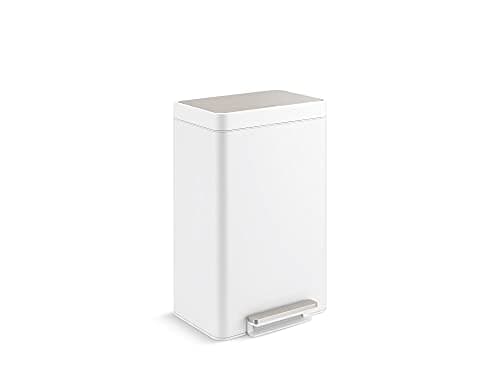
Best value stainless
Kohler 13-Gallon Stainless Steel Step Trash Can (K-20940)
The premium-feeling stainless can that does not lock you into proprietary liners — it is built around the standard 13-gallon bag.
Price as of October 16, 2026. #ad How we make money

Best for big households
simplehuman 55L Rectangular Step Can
The 45L's bigger sibling: identical mechanism and liner pocket, sized for a household that fills a kitchen can every day rather than every three.
Price as of October 16, 2026. #ad How we make money
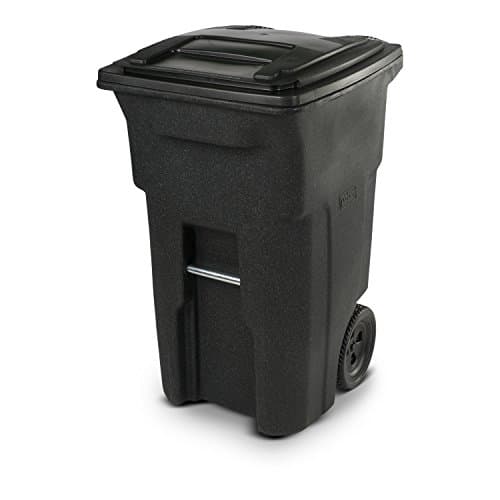
Best outdoor cart overall
Toter Heavy Duty Two-Wheel Trash Cart, 64 Gallon
The cart most municipalities issue, sold retail: rotationally molded, ten-year warranty, and a lid hinged to the body.
$186.95 · 5% off · Price as of October 16, 2026. #ad How we make money
The mistakes families of four make
Buying one big can instead of two streams
A 20-gallon can for everything is almost always worse than a 13-gallon can plus a recycling bin. The landfill stream in a sorting household is small, the recycling stream is bulky and dry, and mixing them means the bulky dry stuff pushes the wet stuff down where it sits. Dual-compartment cans.
Sizing for the worst week of the year
Christmas and birthdays are not a reason to live with an oversized can for the other fifty weeks. Use a bag on the floor for one week a year and buy for the ordinary weeks.
Forgetting who carries the bag out
Thirteen gallons of wet kitchen waste is heavier than people expect, and a thin bag full of it is what splits on the stairs. If the aim is for a teenager to take the trash out, a smaller can quietly makes that likelier. Why trash bags split and what to buy.
Matching the cart to the house instead of the hauler
Outside, the constraint is what your hauler will lift and what you can steer down the driveway. A full 96-gallon cart on a sloped drive is genuinely difficult. 64 versus 96 gallon carts.
Common questions
What size trash can does a family of 4 need?
A 13-gallon kitchen can emptied every other day, plus a 64-gallon wheeled cart outside. Households that do not recycle or compost should consider 15 to 16 gallons inside rather than 20, because 13-gallon bags still stretch to fit.
Is a 13 gallon trash can big enough for a family of 4?
For most, yes - it fills in one to two days, which is the right rhythm. If yours is full before dinner every night, the fix is usually a separate recycling stream rather than a bigger can.
How much trash does a family of 4 produce?
The EPA's published figure is 4.9 pounds per person per day across all municipal solid waste, which works out to roughly 19.6 pounds a day for four people. That counts recycling and composting as well as landfill waste, so treat it as an upper bound.
What size outdoor trash can for a family of 4?
Sixty-four gallons covers a week for most four-person households and is still steerable when full. Ninety-six gallons only makes sense if you have no recycling collection or a long gap between pickups.
Should a family of 4 get a 20 gallon kitchen trash can?
Usually not. You leave the standard tall kitchen bag behind, and a can that takes four or five days to fill is a can whose contents have had four or five days to work on the smell.
How often should a family of 4 empty the kitchen trash?
Every other day as a habit, and daily in summer if anything wet went in. Odor is driven by time and warmth rather than how full the can is.
Sources
Every specification on this page traces to one of these, checked at the time of writing. Where a manufacturer does not publish a figure, the page says so rather than estimating it.
Read next
- Sizes & BagsSize charts, real dimensions, and the bag-fit matrix that does not exist anywhere else.
- Trash can size chartEvery common can size in gallons, liters and quarts, with the matching bag.
- 13 vs 20 gallon trash cansWhy the step up from 13 gallons costs more than the can does, and what to buy at each size.
- The best kitchen trash cans for large familiesFive large-capacity kitchen cans for households that fill a 13-gallon bag before dinner is cleared.
- The best 13-gallon trash cansSix cans at the default American size, and which take standard bags.
- 64 vs 96 gallon trash cansThe two standard curbside cart sizes compared on footprint, full weight and driveway slope.
The author
Ryder M.
Owner and editor of Lid & Liner, published by Magoo Media Group. He started the site after getting tired of the same problem everyone has: every “best trash can” article covers ten products and none of them tells you whether a 13-gallon bag actually fits a 13-gallon can. Lid & Liner covers one category and tries to cover it completely.
Last reviewed October 4, 2026. Spotted an error? Tell us and we will correct it and note the correction.