Where to put a trash can in a small kitchen
Eight options that genuinely work, ranked, plus two that look tempting on a floor plan and go wrong in practice. Start by measuring the gap beside the fridge.
By Ryder M. · Last reviewed September 27, 2026
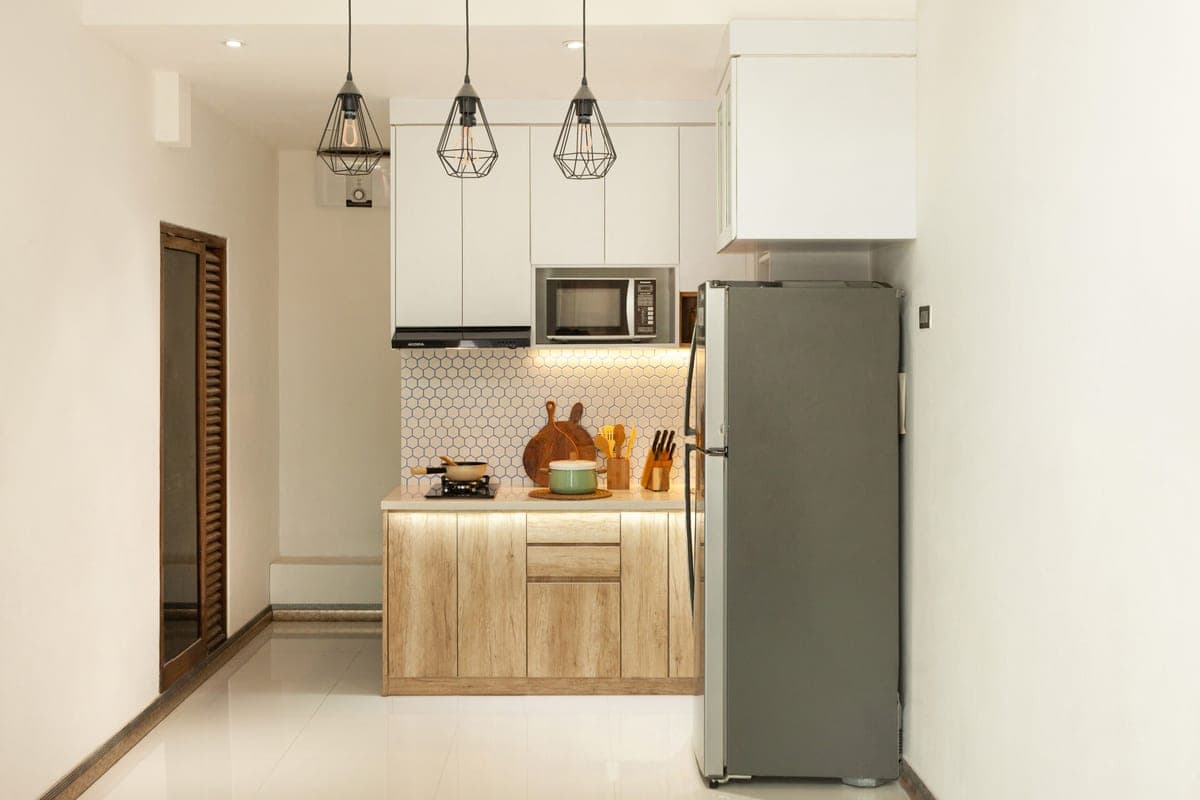
The rule that decides everything
The can has to be within a step or two of where you chop. Everything else is negotiable; that is not.
A can that requires walking across the room does not get used — scraps accumulate on the board, get swept into a bowl, and the bowl sits out. That is the actual failure mode in a small kitchen, and it is why the clever placement that puts the can in the pantry always ends badly. Proximity beats concealment.
The second rule is that you are looking for a gap, not a space. Small kitchens do not have spare floor; they have narrow slots between fixed objects. So measure the slots before you look at cans, then buy something that fits one — not the other way around.
The eight options, ranked
1. The gap beside the refrigerator
Almost every kitchen has one, it is usually four to ten inches wide, and it is usually wasted. A slim can puts full 45-liter capacity in it by going deep rather than wide. This is the best answer in most small kitchens and the one people overlook because the gap does not look like anywhere.
2. Inside the sink cabinet, on a pull-out
Completely out of sight, odor contained behind a door, and right where you rinse. The costs are real: you lose the cabinet, you lose capacity (a 35-quart bucket is about 8.75 gallons), and you have to drill. Measure the clear opening and the depth to the trap, not the cabinet's nominal size. How to measure · the pull-outs themselves.
3. At the end of a run of base cabinets
The dead end of a cabinet run, where the counter stops, is often the only genuinely open floor in the room. A can here is out of the main walkway and the counter above gives you somewhere to put the plate while you scrape. Check the lid swing against the overhanging counter edge.
4. Under a wall-mounted counter or breakfast bar
Good floor, awkward height. This is the classic case for a butterfly lid that folds rather than swings, because there is rarely a foot of clearance under a bar top.
5. In the cabinet, door-mounted
A small bin hung on the inside of a cabinet door. Genuinely useful for scraps while you prep, genuinely too small for the household trash. Treat it as a caddy, not a can — and if that is what you want, a countertop compost bin does the same job better and washes more easily.
6. Between the counter and a wall, in a corner
A rectangular can wastes nothing in a corner; a round one wastes most of it. If this is your slot, buy rectangular and measure both walls, because corners are rarely square in older buildings.
7. Just outside the kitchen doorway
Breaks the proximity rule, so it only works if it is genuinely a step away — the far side of a doorway you pass through constantly, not down a hall. Pair it with a caddy on the counter for scraps so the walk is not required mid-task.
8. Two small cans instead of one big one
The option nobody considers. Two 20-liter cans in two different slots often fit where one 50-liter can does not, and it lets you put the wet fraction in a small can you empty daily and the dry packaging in one you empty weekly. That is also, incidentally, the best odor arrangement in the whole list.
The two that always go wrong
Next to the dishwasher or the oven. Heat is one of the four conditions that make a trash can smell, and a dishwasher vents hot humid air at floor level for an hour each cycle. A can there will smell noticeably worse than the same can four feet away, and no filter fixes it. Why heat matters.
In a pantry or a utility cupboard. It looks like the perfect answer on a floor plan: out of sight, out of the way, plenty of room. In practice it is too far from the board, the door stays shut so there is no airflow, and it becomes the place bags go to be forgotten. If you must, put a small caddy on the counter and treat the pantry can as overflow only.
If nothing fits
Then the honest answer is to change what goes in the can rather than where it goes. Two moves, both free.
Move the wet fraction out — food scraps to a small lidded container in the freezer until collection day, or to a compost caddy. That lets you run a much smaller main can without it smelling, and a smaller can fits places a 13-gallon one does not. Then flatten packaging properly, which is most of the volume in a modern kitchen can and almost none of the weight. Between them, a 30-liter can becomes viable in a kitchen where 50 liters would not fit, and the bag sizing changes too.
Common questions
Where should a trash can go in a small kitchen?
The gap beside the refrigerator, with a slim can that goes deep rather than wide, is the best answer in most small kitchens. Failing that, inside the sink cabinet on a pull-out, or at the dead end of a run of base cabinets.
How do you hide a trash can in a small kitchen?
A pull-out inside the sink cabinet is the only way to hide it completely. Everything else — a slim can in a gap, a corner can — reduces how much you notice it rather than concealing it. Do not hide it somewhere you will not walk to.
Is it bad to put a trash can next to the dishwasher?
Yes. A dishwasher vents hot, humid air at floor level and heat plus damp is exactly what makes a can smell. Move it a few feet if you possibly can; it makes a noticeable difference for free.
What is the best trash can for a tiny kitchen?
A slim 45-liter can that fits a narrow gap, or a pull-out if you can spare the sink cabinet. If neither fits, run a smaller can and move food scraps to the freezer or a caddy so the smaller can still works.
Can I keep the trash can in a cupboard?
In a purpose-built pull-out, yes. In an ordinary cupboard with the door shut, it is a bad idea — no airflow, and it is far enough from the prep area that it stops getting used.
Read next
- Kitchen Trash CansStep cans, stainless, dual recycling and compost — plus the sizing nobody explains.
- The best slim and narrow trash cansSix narrow cans that keep capacity by going deep rather than wide.
- The best under-sink pull-out trash cansSix pull-outs compared on slides, frames and the openings they actually need.
- Kitchen trash can buying guideThe five measurements to take and the emptying-habit question that sets the size.
- How to stop trash can smellSeven steps in order, free ones first, plus the three places residue hides.
- The best countertop compost binsFive caddies compared on cleanability, filters and how sour they go.
The author
Ryder M.
Owner and editor of Lid & Liner, published by Magoo Media Group. He started the site after getting tired of the same problem everyone has: every “best trash can” article covers ten products and none of them tells you whether a 13-gallon bag actually fits a 13-gallon can. Lid & Liner covers one category and tries to cover it completely.
Last reviewed September 27, 2026. Spotted an error? Tell us and we will correct it and note the correction.