Rubbermaid vs Toter
Two brands make the wheeled cart your street actually gets collected in. They are built by different processes, and that is the whole comparison.
By Ryder M. · Last reviewed October 6, 2026

Lid & Liner is reader-supported. If you buy through a link on this page we may earn a commission at no extra cost to you. It never changes which product we rank first — how we pick and how we make money.
The verdict, first
Buy the Toter if you want the cart your hauler probably already runs, built as one seamless rotationally molded piece. Buy the Rubbermaid Commercial BRUTE Rollout if you want the published auto-lifter compliance and the larger wheels, and you do not mind that it looks like it belongs behind a restaurant.
| # | Product | Best for | Price |
|---|---|---|---|
| 01 | 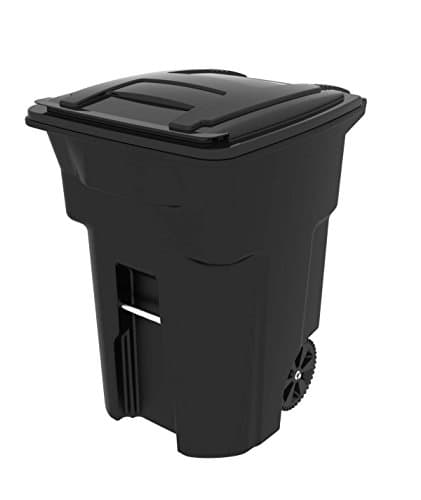 Toter Heavy Duty Two-Wheel Trash Cart, 96 GallonThe 96-gallon cart: the biggest size most automated collection trucks will lift, for households that fill a 64 every week. | Best large capacity | $259.00 · View on Amazon $289.00 · 10% off · Price as of October 16, 2026. #ad How we make money |
| 02 | 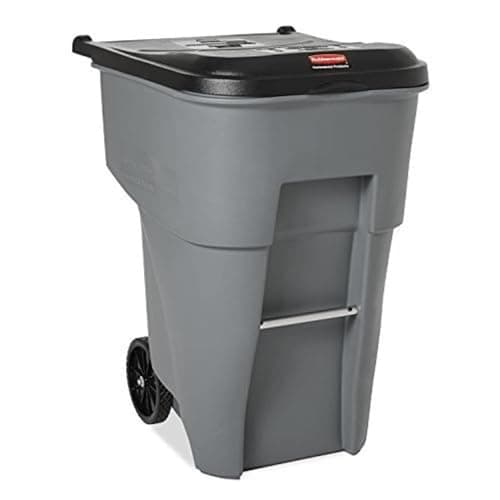 Rubbermaid Commercial BRUTE Rollout Container, 95 GallonThe commercial 95-gallon rollout: a hinged lid that locks back, eight-inch wheels, and compliance with the auto-lifter standard. | Best heavy-duty large cart | $325.78 · View on Amazon $345.99 · 6% off · Price as of October 16, 2026. #ad How we make money |
We matched the two at the closest sizes each brand sells, 96 gallons against 95, because comparing a consumer can to a commercial container tells you nothing. At this size the decision is not capacity. It is how the body is made and whether the truck in your neighborhood can lift it.
The specifications side by side
| Toter Two-Wheel 96 Gallon | Rubbermaid BRUTE Rollout 95 Gallon | |
|---|---|---|
| Capacity | 96 gallons | 95 gallons |
| Construction | Advanced rotational molding, one piece | Heavy-duty polyethylene |
| Lid | Attached, hinged | Attached, hinged, locks back when open |
| Wheels | Two | 8 in heavy-duty |
| Auto-lifter standard | Not stated on the listings we checked | ANSI Z245.60, Types B and G |
| Stated warranty | 10 years | 10 years against manufacturing defects |
| Rim | Rugged Rim, reinforced | Reinforced |
| Empty weight | Not stated on the listings we checked | 38.5 lb |
| Dimensions | Not stated on the listings we checked | 46" H x 37.2" W x 28.6" D |
Both brands warrant these for ten years, which in this category is the number that actually predicts whether you buy another one. Beyond that the table splits cleanly: Toter wins on how the body is formed, Rubbermaid wins on what it publishes about lifting and wheels.
Rotational molding is the Toter argument
Toter forms its carts by advanced rotational molding, which produces one seamless piece with no joints and a wall thickness that can be built up where the stress is. That is why these survive being dragged across concrete, tipped by an automated truck arm and left in the sun for a decade. The Rugged Rim is reinforced because the rim is where a lifter grips, and there is a wear strip on the bottom because the bottom is what gets dragged.
The practical consequence is that there is no seam to split. Cold is what kills outdoor plastic, and a molded joint is the place a freeze finds first. We have not put either cart through a winter under instruction, so treat this as a structural argument rather than a tested result, but it is the reason municipalities standardized on rotationally molded carts in the first place.
The second Toter argument is boring and real: if your hauler already issues Toters, a replacement Toter behaves exactly like the one it replaced, at the same lift height, with the same grip profile. How the standard curbside sizes map to a household week.
Published compliance is the Rubbermaid argument
Rubbermaid states the BRUTE Rollout family is built to ANSI Z245.60, Types B and G, which is the standard that makes a container compatible with automated and semi-automated truck lifters. Toter's carts are the carts municipal fleets run, but the compliance claim we could confirm in writing is Rubbermaid's. If your collection is fully automated and you want a specification you can point at, that is a meaningful difference.
The wheels are the other one. Rubbermaid publishes eight-inch heavy-duty wheels on the 95-gallon Rollout, and wheel diameter is the single thing that decides whether a loaded cart climbs a lip of concrete or stops dead against it. If the path from your side return to the curb includes a step, a driveway apron or a gravel strip, this is the row in the table to care about.
Rubbermaid also publishes the dimensions and the empty weight, which sounds like trivia until you try to work out whether the cart fits through a side gate or between a wall and a car. Thirty-eight and a half pounds empty is also a fair warning: a full 95-gallon container is not a thing you steer casually downhill.
What neither of them solves
An attached lid is not a locked lid
Both carts hinge the lid into the body, which defeats the most common failure in the category: a loose lid that blows away or gets knocked off. Neither lid locks. A raccoon can lever a hinged lid open, and a bear treats both as packaging. If animals are the actual problem, the cart is only half the answer. The straps and locks that finish the job, and what certified bear resistance actually requires.
Size is a weight problem before it is a volume problem
At 95 or 96 gallons a full cart is heavy enough to get away from you on any slope, and heavy enough that the person who takes the trash out matters as much as the spec sheet. Most households are better served by the 64-gallon size, and we laid that trade out in detail. 64 against 96, honestly.
And neither one stops the smell
A hinged lid on a large cart leaves a lot of warm air over a lot of waste for a week. Odor at this scale is managed by bagging properly and rinsing the cart occasionally, not by the cart you chose. What actually works on a can that smells.
What a ten-year warranty actually covers
Both brands put ten years on these carts, and Rubbermaid states its term is against manufacturing defects. That phrasing is the important part, and it is the same in substance across the category: a warranty on a waste cart covers the thing failing because it was made wrong, not the thing failing because a truck dropped it, a plow clipped it or it spent six Julys in direct sun.
In practice that means a cracked body in year two is usually a claim and a cracked body in year eight usually is not, because by then the cause is accumulated UV and cold rather than a molding fault. Neither company life-tests a cart in your driveway, and we have not either. Keep the purchase record, because a warranty you cannot date is a warranty you cannot use.
What the warranty never covers is the wheels and the lid hinge, which are the parts that actually wear out. Both brands sell or supply replacement parts for commercial lines, and a cart with a new wheel is a cart you keep rather than replace.
How to make either one last the ten years
- Bag everything, including the wet things. Loose waste against the wall is what makes a cart need scrubbing, and scrubbing is what scratches the inside surface that then holds the next lot of residue.
- Do not overfill past the rim. A lid that cannot close is a lid being levered on its hinge every collection day, and the hinge is the part with no warranty.
- Park it out of direct afternoon sun if you have the choice. UV is what makes outdoor plastic chalky and then brittle, and shade costs nothing.
- Rinse it two or three times a year, in the shade, and let it dry with the lid open rather than closed on a wet interior.
- Strap the lid if animals visit. A strap costs a fraction of the cart and prevents the one failure mode that ends most carts early, which is a lid forced past its travel.
None of that is brand-specific, which is rather the point: at this end of the market the cart you chose matters less than whether the lid closes and the body stays out of the sun. The full cleaning method, including what not to use.
If 95 gallons is too much cart
Both brands scale down, and for most households the smaller size is the right one. The Toter 64 is the size most municipal fleets issue; the Rubbermaid Rollout 32 is the same commercial lid and wheel design in a cart one person can steer when it is full.
Best outdoor cart overall
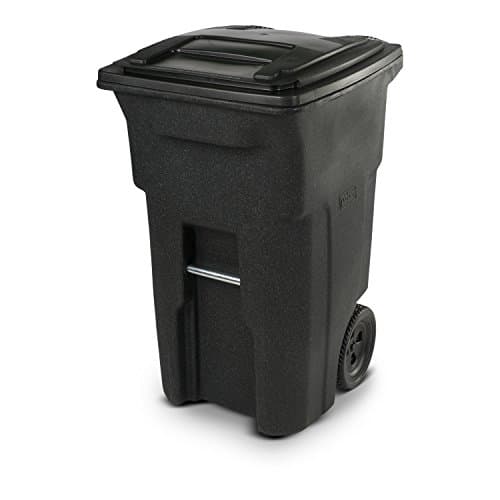
Toter Heavy Duty Two-Wheel Trash Cart, 64 Gallon
The cart most municipalities issue, sold retail: rotationally molded, ten-year warranty, and a lid hinged to the body.
$186.95 · 5% off · Price as of October 16, 2026. #ad How we make money
Best commercial 32-gallon
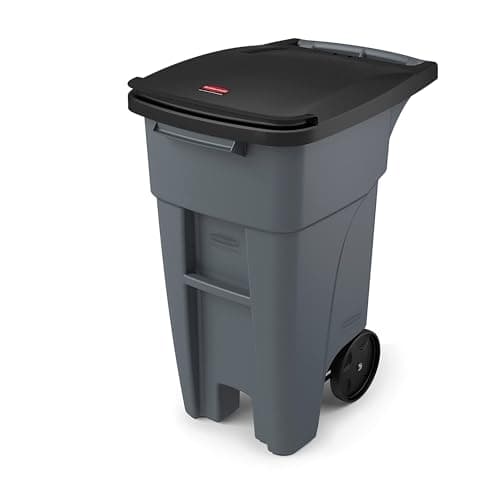
Rubbermaid Commercial BRUTE Rollout Container, 32 Gallon
The smallest BRUTE Rollout: the same hinged-lid, auto-lifter-rated build scaled to a can one person can steer when full.
Price as of October 16, 2026. #ad How we make money
Buy A if, buy B if
| Buy the Toter if | Buy the Rubbermaid if |
|---|---|
| Your hauler already runs Toters | Your collection is fully automated |
| You want one seamless molded body | You want published lifter compliance |
| You want the slightly larger capacity | Your path to the curb has a step or gravel |
| You want the lower lift height | You need the dimensions before you buy |
| The cart lives where people see it | The cart lives down a side return |
If you are choosing a brand rather than a size, the wider Rubbermaid range is worth seeing first, because most of it is cheaper and aimed at households rather than loading docks. The Rubbermaid line ranked. And for the cross-brand view, the whole outdoor field or just the carts with wheels.
If the comparison has already settled in Toter's favour, the next question is which size, and that is a question about your hauler as much as your household: the best Toter trash cans, size by size.
Common questions
Is Toter better than Rubbermaid?
For the cart body, Toter has the stronger argument: advanced rotational molding produces one seamless piece with no seam to split. Rubbermaid publishes more about lifter compliance and wheel size. Both warrant their large carts for ten years.
Are Toter and Rubbermaid carts auto-lifter compatible?
Rubbermaid states the BRUTE Rollout family meets ANSI Z245.60, Types B and G. Toter carts are the type municipal fleets run, but we could not confirm a written compliance claim for the retail two-wheel carts, so check with your hauler.
Which cart has better wheels?
Rubbermaid, on published figures - eight-inch heavy-duty wheels on the 95-gallon Rollout. Wheel diameter is what decides whether a loaded cart climbs a concrete lip or jams against it.
How long do these carts last?
Both brands put a ten-year warranty on these, Rubbermaid's against manufacturing defects. That is the number worth comparing, because nobody has independently life-tested either one over a decade of real collections.
Will either cart keep raccoons out?
Not by itself. Both lids are hinged to the body, which stops a lid blowing away, but neither locks. Add a strap or a lid lock if animals are a regular problem.
Should I get 95, 96 or 64 gallons?
Sixty-four for most households. Go to 95 or 96 only if you are currently putting a second can out every collection day, and only if your driveway is flat - a full cart that size is genuinely hard to steer.
Sources
Every specification on this page traces to one of these, checked at the time of writing. Where a manufacturer does not publish a figure, the page says so rather than estimating it.
Read next
- Outdoor Trash CansCurbside carts, animal-proofing, enclosures and the sizes your hauler accepts.
- The best Rubbermaid trash cansFive Rubbermaid BRUTE containers ranked, and the Roughneck-versus-BRUTE split nobody explains at the shelf.
- The best outdoor trash cansSix outdoor cans on construction, lid design and what your hauler will lift.
- 64 vs 96 gallon trash cansThe two standard curbside cart sizes compared on footprint, full weight and driveway slope.
- The best 96 gallon trash cansThree carts at the largest standard curbside size, ranked on build and how they steer when full.
- The best trash can lid locks and strapsFour straps and locks on fit range, materials and winter survival.
The author
Ryder M.
Owner and editor of Lid & Liner, published by Magoo Media Group. He started the site after getting tired of the same problem everyone has: every “best trash can” article covers ten products and none of them tells you whether a 13-gallon bag actually fits a 13-gallon can. Lid & Liner covers one category and tries to cover it completely.
Last reviewed October 6, 2026. Spotted an error? Tell us and we will correct it and note the correction.