Outdoor trash can sizes
Thirty-two, 64 and 96 gallons are the standard curbside sizes because that is what automated trucks are built around. Here is what each one means in practice.
By Ryder M. · Last reviewed September 27, 2026
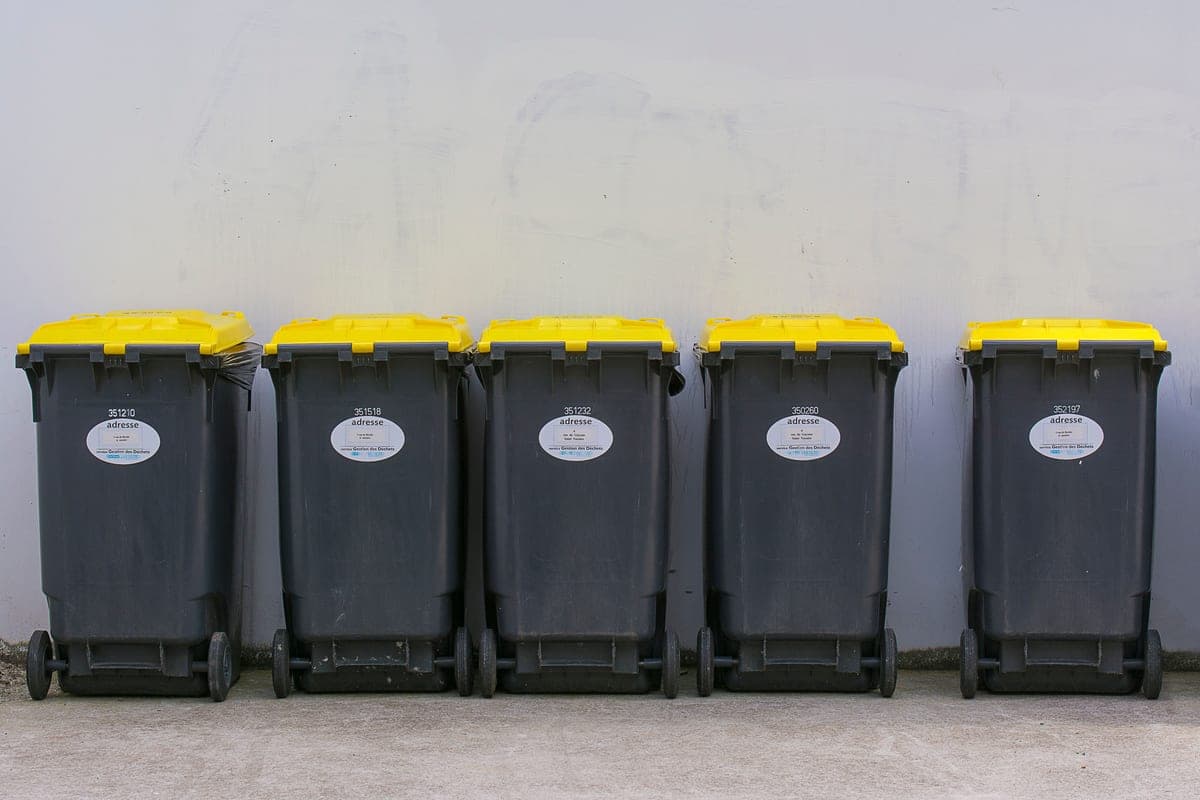
The standard sizes
Thirty-two, 48, 64 and 96 gallons are the standard two-wheel cart sizes. Those numbers are not arbitrary: automated collection trucks grip a cart by its body, and the arms are built around those profiles.
| Gallons | Liters | Suits | Practical notes |
|---|---|---|---|
| 32 gal | 121 L | One or two people, a tight side return | Steerable when full by almost anyone |
| 48 gal | 182 L | A small family | Less commonly stocked at retail |
| 64 gal | 242 L | A typical family — the most common size | The usual default, and manageable full |
| 96 gal | 363 L | Households that would otherwise put out two cans | Genuinely heavy to steer full; check your hauler lifts them |
| 20-45 gal (free-standing) | 76-170 L | Patios, decks, workshops | Not designed for automated collection |
For every indoor size, and the full conversion arithmetic, the main size chart is here.
Check three things before you buy
- Does your municipality issue carts? If so, buying your own may be entirely wasted money, and in some places a non-issued cart will not be collected at all.
- Is the collection automated or manual? An automated arm needs a compatible cart profile and cannot lift an old-fashioned round can with a loose lid. Manual collection is far more forgiving about what the can is.
- What is the largest size your hauler accepts? Not everyone lifts 96s. Buying one that gets left at the curb is an expensive lesson.
Those three questions take one phone call and they determine most of the decision. Everything below assumes you have answered them.
How to size it for your household
A rough working figure is that a household generates somewhere around 15 to 25 gallons of general waste per person per week, before recycling is separated out. That is a wide band because households differ enormously — whether you compost, how much packaging you buy, whether there is a baby in the house.
Rather than trusting a rule of thumb, do the direct version: for two weeks, note whether the can is overflowing, full, or has room on collection day. Overflowing means size up. Half full means you are paying for air — and a cart that is half full is also a cart that is harder to keep upright in wind.
| On collection day | Action |
|---|---|
| Overflowing, or a second bag beside it | Size up one step |
| Full but closes properly | Correct size |
| Around half full | Size down, or recycle less into it |
| A quarter full | Size down — a big empty cart blows over |
One counter-intuitive point: sizing up does not help with smell. A larger cart means waste sits longer before it is worth putting out, and odor is a function of time and temperature. If your problem is smell rather than capacity, the answer is elsewhere.
The practical limits nobody mentions
Weight and steering
A full 96-gallon cart is a genuinely awkward object. It steers on two wheels with all the weight above the axle, and if your driveway slopes, has a step, or turns a corner, it is a different proposition from a 64. Toter designs a lower handle height specifically to make tilting easier, which tells you the problem is real. If anyone in the household would struggle with it, buy two 64s rather than one 96.
Storage footprint
A 96-gallon cart is a large object standing somewhere for six days a week. Measure the side return or the store before you buy, and remember the lid needs clearance to open. Enclosures that take modern carts — and note that plenty of enclosures are sized for old 32-gallon cans and will not take a 64.
Lining a cart
Most people do not line curbside carts at all, and that is normal — bagged waste goes in loose. If you want a liner, a 64-gallon cart takes a 55-65 gallon drum liner and a 96 takes a 95-gallon cart liner, both of which are commercial rather than supermarket products. The bag size ladder.
Free-standing cans are sized differently
Patio and deck cans do not follow the cart sizes, because they are not going in front of a truck. They cluster around 30 to 45 gallons and are usually specified by the liner they take rather than a nominal capacity — Suncast's Trash Hideaway, for instance, is specified as taking standard 30-33 gallon liners, with an exterior of 17 by 17 by 31.5 inches and an interior of 14 by 14 by 26.
That interior figure is the useful one and it is unusually honest of Suncast to publish it: it tells you exactly what will fit. Most manufacturers in this category publish only exterior dimensions, which tells you whether it fits your deck but nothing about whether your liner fits it.
The three sizes most households actually choose between: the default cart, the small cart, and a patio can that takes a standard 30-33 gallon liner.
Best outdoor cart overall
Toter Heavy Duty Two-Wheel Trash Cart, 64 Gallon
The cart most municipalities issue, sold retail: rotationally molded, ten-year warranty, and a lid hinged to the body.
Best small outdoor cart
Toter Heavy Duty Two-Wheel Trash Cart, 32 Gallon
The 32-gallon Toter, for a small household, a tight side return, or anyone who cannot manage a 64 when it is full.
Best for patios and decks
Suncast Trash Hideaway Refuse Container, 33 Gallon
A latching-lid resin can with a wicker texture, for the deck or patio where a municipal cart would look wrong.
Common questions
What are the standard outdoor trash can sizes?
Thirty-two, 48, 64 and 96 gallons for two-wheel curbside carts. Sixty-four is the most common. Free-standing patio cans cluster around 30 to 45 gallons and follow different conventions.
What size trash can do I need for a family of four?
Sixty-four gallons is the usual answer. Check for two weeks whether the cart is overflowing, full, or half empty on collection day and adjust from there — that beats any rule of thumb.
How many gallons is a standard curbside trash cart?
Sixty-four gallons, which is 242 liters. Thirty-two and 96-gallon versions are the common alternatives, and not every hauler lifts 96s.
Is a 96 gallon trash can too big?
It is genuinely heavy to steer full, with all the weight above a two-wheel axle. If your driveway slopes or has a step, or if anyone in the household would struggle, two 64s are the better answer.
What size bag fits a 64 gallon trash cart?
Most people do not line curbside carts at all. If you want to, a 55-65 gallon drum liner fits a 64-gallon cart — that is a commercial product rather than a supermarket one.
Will a bigger outdoor can smell less?
No, worse. A larger cart means waste sits longer before it is worth putting out, and odor is a function of time and temperature rather than volume.
Sources
Every specification on this page traces to one of these, checked at the time of writing. Where a manufacturer does not publish a figure, the page says so rather than estimating it.
Read next
- Outdoor Trash CansCurbside carts, animal-proofing, enclosures and the sizes your hauler accepts.
- Trash can size chartEvery common can size in gallons, liters and quarts, with the matching bag.
- The best outdoor trash cansSix outdoor cans on construction, lid design and what your hauler will lift.
- The best outdoor trash cans with wheelsFive wheeled cans on construction, warranty and the axle that actually fails.
- Trash bag sizes explainedThe full ladder, mil thickness explained, and the 13-to-20-gallon gap.
- The best outdoor trash can enclosuresFive enclosures on what they actually fit, and the lift-lid detail that matters.
The author
Ryder M.
Owner and editor of Lid & Liner, published by Magoo Media Group. He started the site after getting tired of the same problem everyone has: every “best trash can” article covers ten products and none of them tells you whether a 13-gallon bag actually fits a 13-gallon can. Lid & Liner covers one category and tries to cover it completely.
Last reviewed September 27, 2026. Spotted an error? Tell us and we will correct it and note the correction.