Garden waste is heavy, wet and abrasive, which breaks the two things a normal can is bad at: lifting the bag out, and surviving being dragged. Venting and wheels are the whole decision.
Lid & Liner is reader-supported. If you buy through a link on this page we may earn a commission at no extra cost to you. It never changes which product we rank first — how we pick and how we make money.
02
The short answer
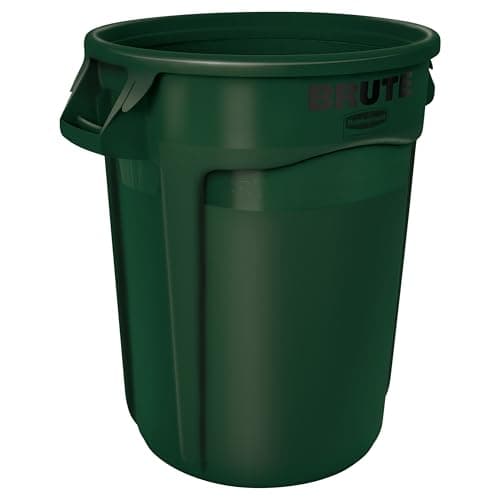
Buy the Rubbermaid Commercial BRUTE 32 Gallon Vented Container. The venting channels in the body are the reason it is here: a bag full of wet leaves forms a vacuum in a smooth can and tears when you pull it, and the BRUTE simply does not do that. The budget pick is the Rubbermaid Commercial BRUTE 20 Gallon, the cheapest can here and the one to buy if you are filling it by hand and carrying it. If the waste has to travel any distance, go straight to a wheeled can - the BRUTE Rollout 32 Gallon for a garden path, the Toter 64 Gallon for a full green-waste collection.
#
Product
Best for
Price
01
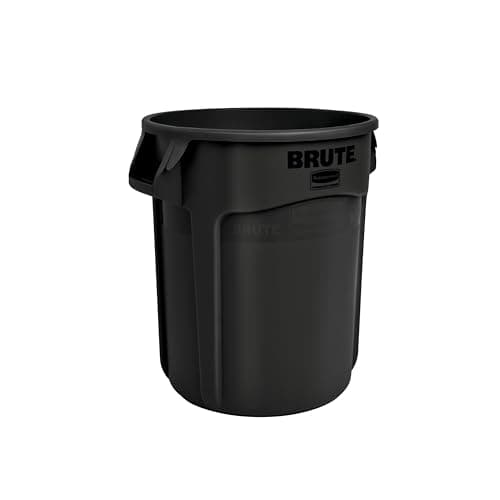
Rubbermaid Commercial BRUTE 32 Gallon Vented ContainerThe commercial standard, and the only can here that solves the vacuum-stuck bag properly.
Rubbermaid Commercial BRUTE 20 Gallon Vented ContainerThe small BRUTE: a 20-gallon round container built to be dragged, with the venting channels that make bag day survivable.
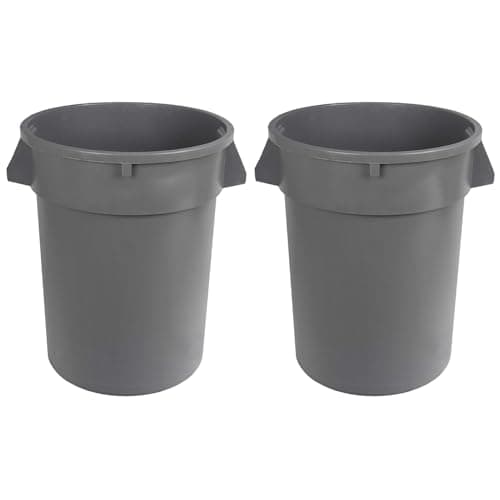
Amazon Basics Heavy Duty Round Trash Can, 32 Gallon, Grey, Pack of 2A pair of plain 32-gallon utility containers - the cheapest way to stand up a two-stream garage or yard-waste station.
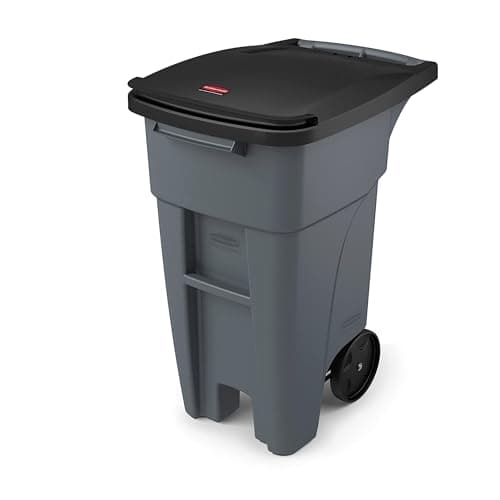
Rubbermaid Commercial BRUTE Rollout Container, 32 GallonThe smallest BRUTE Rollout: the same hinged-lid, auto-lifter-rated build scaled to a can one person can steer when full.
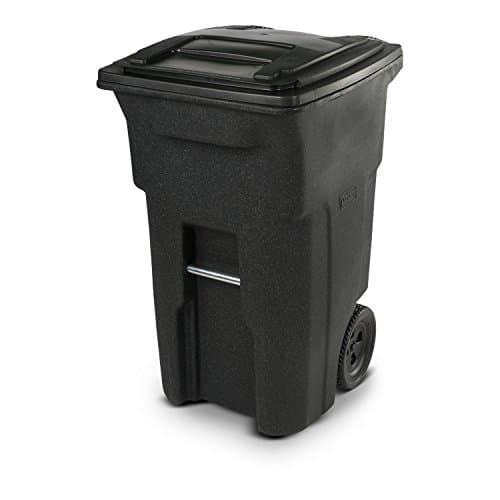
Toter Heavy Duty Two-Wheel Trash Cart, 64 GallonThe cart most municipalities issue, sold retail: rotationally molded, ten-year warranty, and a lid hinged to the body.
$186.65 · 10% off · Price as of November 14, 2026. #adHow we make money
Before you buy anything, check how your town collects garden waste. Many municipalities require a specific cart they supply, and several refuse plastic-bagged yard waste entirely. Where that applies, the right purchase is a holding can for the week, not a collection cart.
03
Why yard waste breaks normal cans
Weight. Wet leaves and soil are dense. A 32-gallon can filled with soaked clippings is heavier than the same can full of household waste, which is why the thin-walled supermarket can cracks at the rim.
Suction. A soaked bag against smooth plastic forms a seal. Venting channels in the body break it - this is the single most useful feature in the category and it is the reason three of these picks are commercial cans.
Abrasion. Twigs, grit and stones scour the inside. Commercial-grade resin takes it; a decorative resin can does not.
Drag. Yard waste gets pulled across gravel and paving. Two wheels and a molded base are what keep the bottom intact over several seasons.
The bag matters as much as the can. A kitchen bag will not survive this - the best trash bags for outdoor trash cans covers the 1.2 and 1.7 mil liners that will, and the cut that actually fits a 32-gallon round can.
04
Who each pick is for
Pick
Who it is for
Capacity
Wheels
Rubbermaid BRUTE 32 Gallon Vented
The default - venting makes the wet bag come out
32 gal
No
Rubbermaid BRUTE 20 Gallon
Cheapest can, carried by hand
20 gal
No
Amazon Basics Heavy Duty Round, 2-pack
Clippings and compostables in separate cans
32 gal each
No
Rubbermaid BRUTE Rollout 32 Gallon
Moving the waste down a path or drive
32 gal
Yes
Toter Heavy Duty 64 Gallon Cart
A real green-waste collection each week
64 gal
Yes
Capacities and venting are the manufacturers' own figures from their product pages.
The commercial standard, and the only can here that solves the vacuum-stuck bag properly.
Capacity
32 gallons
Venting
Molded channels — liners up to 50% easier to remove
Bag retention
Integrated cinches
Lid
Flat top with snap-lock, separate part
Base
Heavy-duty reinforced
Standards
NSF 2 and 21; USDA Meat and Poultry listed
Anyone who has fought a wet bag out of a smooth-sided can knows the problem: suction. Rubbermaid molds venting channels into the BRUTE's walls that let air in behind the bag, and states liners come out up to 50% more easily as a result. Integrated cinches let you tie the bag to the handles without knotting it. It meets NSF 2 and 21 and is USDA Meat and Poultry listed, which tells you the surface genuinely cleans.
What we'd flag: no wheels and no attached lid at this size. The snap-lock lid holds, but it is a separate part — which means it is a part that gets left on the ground and blows down the street.
The small BRUTE: a 20-gallon round container built to be dragged, with the venting channels that make bag day survivable.
Capacity
20 gallons
Dimensions
22.34" L x 19.38" W x 22.88" H
Weight
5.5 lb empty
Venting
Moulded channels — bag removal up to 50% easier (manufacturer figure)
Bag retention
Integrated cinches, tested to 20,000 cycles
Lid
Sold separately
A wet bag in a smooth-sided can forms a vacuum, and that is the moment cheap cans tear. Rubbermaid moulds venting channels down the inside wall and states bag removal is up to 50 percent easier as a result; integrated cinches hold the liner by the rim and are tested to 20,000 cycles. The base is engineered to be dragged over rough ground, the rim has an internal rib structure against crushing, and the body carries a UV inhibitor. Twenty gallons is the size that fits under a workbench and still takes a full bag.
What we'd flag: the lid is a separate purchase, as it is across the whole BRUTE line. Without one this is an open container, which is fine in a garage and wrong anywhere food waste goes.
Amazon Basics Heavy Duty Round Trash Can, 32 Gallon, Grey, Pack of 2
A pair of plain 32-gallon utility containers - the cheapest way to stand up a two-stream garage or yard-waste station.
Capacity
32 gallons each
Sold as
Pack of 2
Material
Molded plastic, grey
Lid
Not stated on the listing
Liner
30-33 gallon
A garage can does not need a mechanism, a finish or a damper. It needs volume, a body that survives being dragged, and a price that lets you buy two so trash and recycling are separated at the source. That is exactly what this is. Thirty-two gallons is also the size the rest of the hardware world is built around, so lids, dollies, straps and 30-33 gallon liners all fit it.
What we'd flag hardest: the listing states the capacity and the material and little else - it does not state that a lid is included, so budget for a separate lid or a strap if the can lives outside. It is also only sold as a two-pack, which is wasted money if you want one.
The smallest BRUTE Rollout: the same hinged-lid, auto-lifter-rated build scaled to a can one person can steer when full.
Capacity
32 gallons
Lid
Attached, hinged
Wheels
Heavy-duty, curb-capable
Material
Heavy-duty polyethylene
Family
BRUTE Rollout — also 50, 65 and 95 gallon
The whole point of a Rollout at 32 gallons is that you get the commercial lid and wheel design without the weight. The lid is part of the container, so there is nothing to blow away or be knocked off, the wheels are sized to climb a curb, and the body is the same heavy-duty polyethylene as the 95. For a household with a short, awkward path to the curb this is the one that does not need two people.
What we'd flag: commercial containers are priced commercially. Against a consumer 32-gallon wheeled can you are paying a real premium for the hinged lid and the wheel size — worth it only if the path to your curb is genuinely rough.
The cart most municipalities issue, sold retail: rotationally molded, ten-year warranty, and a lid hinged to the body.
Capacity
64 gallons
Construction
Advanced rotational molding, one piece
Rim
Rugged Rim, reinforced
Base
Bottom wear strip
Wheels
Two
Warranty
10 years
Toter builds these with an advanced rotational molding process — one seamless piece with a reinforced Rugged Rim and a bottom wear strip, which is why they survive being dragged across concrete and tipped by an automated truck arm. The attached hinged lid is the security feature that matters most: a raccoon cannot knock a lid off a can when the lid is part of the can. The lower handle height also makes it easier to tilt than it looks.
What we'd flag: an attached hinged lid is not a locked lid. A determined raccoon can still lever it open, which is why this pairs with a strap rather than replacing one.
$186.65 · 10% off · Price as of November 14, 2026. #adHow we make money
06
Running a yard waste can well
Keep it unlidded while you work, lidded afterwards. An open can fills faster; a lidded one does not fill with rain and double in weight overnight.
Rinse it after the last load of the season. Rotting plant matter in a can over winter is the worst smell in this entire category - how to clean an outdoor garbage can has the method.
Do not use it as your household can afterwards. Grit scours the inside and the can will not come clean again. A dedicated 20-gallon is cheaper than ruining a good cart.
The Rubbermaid Commercial BRUTE 32 Gallon Vented Container. The venting channels break the vacuum that forms around a bag of wet leaves, which is the one failure that defines this category.
Why do yard waste bags get stuck in the can?
A soaked bag seals against smooth plastic and creates suction. Vented cans have channels molded into the body specifically to break that seal.
What size can do you need for leaves?
32 gallons is the practical maximum you can lift once it is full of wet leaves. Go to a 64-gallon wheeled cart only if you are never lifting it.
Can you put yard waste in a normal trash can?
Physically yes, but many municipalities collect green waste separately and some refuse bagged yard waste entirely. Check your local rules before buying a cart.
What bag should you use for garden waste?
A 1.2 mil liner at minimum, cut 30 by 36 inches for a 32-gallon round can. For twigs and sharp debris, 1.7 mil.
Are wheels worth it for a yard waste can?
If the waste travels further than a few steps, yes. Dragging a full can over gravel is what destroys the base of an unwheeled can.
08
Sources
Every specification on this page traces to one of these, checked at the time of writing. Where a manufacturer does not publish a figure, the page says so rather than estimating it.
Owner and editor of Lid & Liner, published by Magoo Media Group. He started the site after getting tired of the same problem everyone has: every “best trash can” article covers ten products and none of them tells you whether a 13-gallon bag actually fits a 13-gallon can. Lid & Liner covers one category and tries to cover it completely.
Last reviewed November 10, 2026. Spotted an error? Tell us and we will correct it and note the correction.