Bear-resistant vs bear-proof
One of those terms describes a product that has been through a defined test with captive grizzlies. The other is a word on a box. Knowing which is which is the whole of this purchase.
By Ryder M. · Last reviewed October 10, 2026

Lid & Liner is reader-supported. If you buy through a link on this page we may earn a commission at no extra cost to you. It never changes which product we rank first — how we pick and how we make money.
The short answer
Bear-resistant is a tested standard. Bear-proof is not a standard at all. The Interagency Grizzly Bear Committee certifies products as bear-resistant, meaning they have met minimum standards for the effort a grizzly must expend to reach the contents - and the IGBC states plainly that its certification does not guarantee a product is bear-proof, nor that it will never be breached. So buy a container that is IGBC certified and ignore any product that calls itself bear-proof without naming a certification, because the second claim has nothing behind it.
This matters practically, not just semantically. Many jurisdictions in bear country require certified containers by ordinance, and some specify which models. A can marketed as bear-proof with no certification may not satisfy a requirement that a certified one would.
What IGBC certification actually certifies
The Interagency Grizzly Bear Committee runs the testing program that wildlife agencies across the United States reference. Its certification indicates that a commercially available product has, in the committee's words, "met minimum standards related to the effort that must be expended by grizzly bears to access the container's contents."
Read that carefully, because every word is doing work. It is a standard about effort, not about impossibility. And the IGBC is explicit about the limit: "IGBC certification does NOT guarantee that a product is BEAR-PROOF; nor does certification by the IGBC guarantee that a product will never be breached by bears."
- It is tested, not asserted. A product either passes a live bear test using captive grizzlies or goes through a technical evaluation to gain certification.
- The testing happens at named facilities. The Grizzly and Wolf Discovery Center in West Yellowstone, Montana, and the Washington State University Bear Center in Pullman, Washington.
- The certified list is large and maintained. Nearly 500 certified products from more than 100 manufacturers, kept current through annual manufacturer verification.
- Certification assumes correct use. The committee's own example is blunt: an unlocked cooler is not bear-resistant. A latch you did not close certifies nothing.
- It is about grizzlies. That is a higher bar than a black bear, which is what most of the lower 48 is actually dealing with.
So what does bear-proof mean on a box?
Commercially, nothing verifiable. It is the term people search for - which is why we use it in our roundup of bear-proof trash cans - but no body certifies products as bear-proof, so any listing using the word is either loosely describing a certified bear-resistant product or making a claim nobody checked.
| Claim on the listing | What it tells you | What to do |
|---|---|---|
| IGBC certified | Passed a live bear test or a technical evaluation | This is the claim worth paying for |
| IGBC tested | Went through testing; confirm the certification itself | Check the product on the IGBC certified list |
| Three Star, Living with Wildlife | A separate program's highest rating | A useful second signal alongside certification |
| Bear-proof | Nothing verifiable on its own | Look for a certification elsewhere on the page |
| Bear-resistant, no body named | An unverified use of a real term | Treat as uncertified |
| Heavy-duty, animal-resistant, raccoon-proof | A different and much lower bar | Fine for raccoons; not for bears |
That bottom row is worth separating out properly. Raccoon-resistance and bear-resistance are different engineering problems - a raccoon has hands and patience, a bear has several hundred pounds of force. A latch that defeats a raccoon is often simply torn off by a bear. If raccoons are the actual animal at your curb, you want raccoon-proof cans and you can spend a lot less.
What makes a container actually resistant
Certification is a result; these are the design features that produce it. Looking for them tells you whether an uncertified container is in the right ballpark or is a normal cart with a strap.
- The lid is structural, not a cover. Double-wall rotationally molded lids resist being crushed or peeled; a single-skin lid folds.
- The hinges are steel and through-bolted. Quarter-inch steel U-bolt hinges are what hold a lid on when a bear puts weight on the back of it. Molded plastic hinge lugs shear.
- The latch resists prying, not just lifting. A bear works the gap between lid and rim with claws. The latch has to hold against that, which is why certified latches are harder for you to operate too.
- The rim is reinforced. A deformed rim opens a gap, and a gap is all a bear needs.
- The body does not flex open. Rotational molding gives a seamless wall of even thickness; a two-part body has a joint to exploit.
Notice what is not on that list: weight. A bear can move a full cart easily, and a heavy cart that opens when it goes over is just a heavy open cart. Containment is about the lid and the hinges, every time.
The two ends of what is actually buyable: an IGBC-certified steel container, and the lid lock you fit to the cart you already have while you ask your hauler about a certified one.
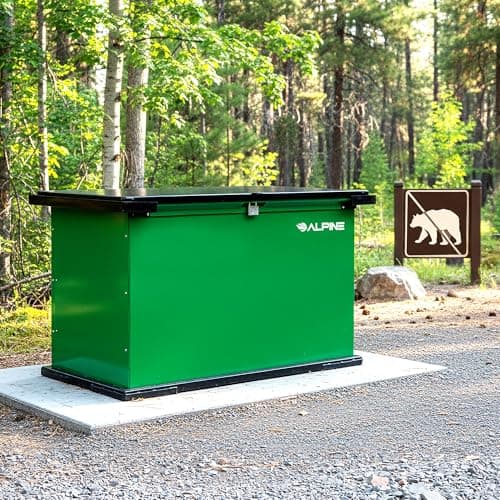
Best certified bear-resistant container
Alpine Bear Proof Garbage Can, IGBC Certified, 197 Gallon
The one genuinely certified bear-resistant container you can buy online: structural steel, a locking pry-resistant lid, and IGBC certification behind it.
Price as of October 16, 2026. #ad How we make money
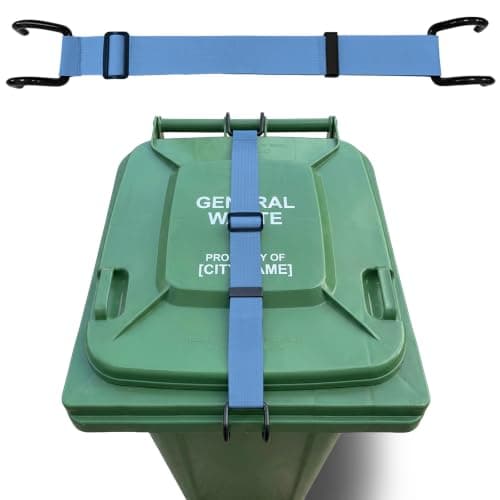
Best retrofit for a can you own
ANKS Bear and Raccoon Proof Trash Can Lock
A hooked strap that clamps a lid to a rim on anything from a 28-gallon can to a 96-gallon cart, for the price of a takeaway.
$18.99 · 11% off · Price as of October 16, 2026. #ad How we make money
Buy the certification in a size your hauler collects
This is the mistake that wastes the most money in bear country. People buy a specialty container, and then discover their hauler's automated truck cannot lift it or the driver will not work a latch from the cab. A certified container you have to empty by hand into a different cart has defeated its own purpose.
- 64 and 96 gallons are the standard collection sizes. A certified cart in one of those sizes keeps your normal service. Toter builds the Bear Tough in exactly those two.
- Call your hauler before you buy. Ask specifically whether they will service a latched cart, and whether the driver is expected to re-latch it.
- Check your local ordinance. Some jurisdictions mandate certified containers, and a few name acceptable models. That list, not a product page, is the authority where you live.
- Expect a shorter warranty. Toter warrants its standard two-wheel carts for 10 years and the Bear Tough carts for 3 - the latch and hinges take far more load than an ordinary lid does.
Wildlife agencies publish guidance on all of this for their own states, and it is better guidance than any retailer's. Vermont Fish and Wildlife's page on bear-resistant trash containers is a good example of what to look for locally. If you are choosing between the two big cart sizes, that decision is unchanged by certification.
The container is the second-best answer
Every agency says the same thing and it is worth repeating before you spend several hundred dollars: the most effective change is not storing the attractant outside at all, and the second is putting the cart out on collection morning rather than the night before. A bear that finds nothing for a week stops checking.
That is also why cart capacity matters in bear country. Putting the trash out on the morning only works if the cart holds everything you generated since the last pickup, which is the real argument for the 96-gallon certified cart over the 64 for a larger household.
- Store the cart in a garage, shed or enclosure until collection morning. Outdoor enclosures.
- Put it out in the morning, never overnight. This single habit does more than any product.
- Freeze the strong-smelling waste until collection day - meat trays, bones, fish.
- Keep the cart clean. Residue is what the bear smells from a distance. How to clean an outdoor garbage can.
- Latch it every single time. An unlatched certified cart is an ordinary cart, which is the IGBC's own point about the cooler.
If you already own a cart and want to improve it rather than replace it, be realistic about the ceiling: straps and aftermarket locks are raccoon-grade hardware and a bear will usually defeat them. The honest options are set out in how to make a trash can bear proof and lid locks and straps.
Common questions
What is the difference between bear-resistant and bear-proof?
Bear-resistant is a tested standard - the IGBC certifies products as having met minimum standards for the effort a grizzly must expend to reach the contents. Bear-proof is not a standard, and no body certifies it.
Does IGBC certification mean a bear cannot get in?
No, and the IGBC says so directly: certification does not guarantee a product is bear-proof or that it will never be breached. It means a bear has to work harder than it is usually willing to.
How are bear-resistant containers tested?
A product either passes a live bear test with captive grizzlies or goes through a technical evaluation. The live testing is done at the Grizzly and Wolf Discovery Center in West Yellowstone, Montana and the Washington State University Bear Center in Pullman, Washington.
Is a bear-resistant trash can worth the money?
In bear country, yes - but only in a size your hauler collects, and only if you latch it every time. An unlatched certified cart is just a cart, which is the point the IGBC makes about unlocked coolers.
Will a strap or a lock make my trash can bear-resistant?
No. Aftermarket straps and bungee locks are raccoon-grade hardware. A bear defeats them by force, and no amount of them produces a certified container.
Do I need a certified container for black bears?
IGBC testing uses grizzlies, which is a higher bar than a black bear, so a certified container is more than sufficient. Check your local ordinance though - some jurisdictions require certified containers regardless of which species is local.
Sources
Every specification on this page traces to one of these, checked at the time of writing. Where a manufacturer does not publish a figure, the page says so rather than estimating it.
Read next
- Outdoor Trash CansCurbside carts, animal-proofing, enclosures and the sizes your hauler accepts.
- The best bear-proof trash cansCertified bear-resistant carts ranked on size, latch and whether your hauler can still collect them.
- How to make a trash can bear proofWhy retrofits mostly do not work, what certification means, and the routine.
- The best Toter trash cans, size by sizeAll four Toter cart sizes plus the bear-resistant version, and how to pick the one your hauler will actually collect.
- The best raccoon-proof trash cansStraps and cans compared — and why the cheapest option is usually the answer.
The author
Ryder M.
Owner and editor of Lid & Liner, published by Magoo Media Group. He started the site after getting tired of the same problem everyone has: every “best trash can” article covers ten products and none of them tells you whether a 13-gallon bag actually fits a 13-gallon can. Lid & Liner covers one category and tries to cover it completely.
Last reviewed October 10, 2026. Spotted an error? Tell us and we will correct it and note the correction.