Trash can without a lid: when open-top is the right answer
An open can has nothing to break, nothing to slam and nothing to fingerprint. It also does nothing about smell or flies. The whole decision comes down to what goes in it.
By Ryder M. · Last reviewed October 10, 2026

Lid & Liner is reader-supported. If you buy through a link on this page we may earn a commission at no extra cost to you. It never changes which product we rank first — how we pick and how we make money.
The short answer
Buy a can without a lid wherever food waste does not go, and a lidded can wherever it does. That is the entire rule. An open can is faster to use, has no mechanism to fail, needs no bag-fit compromise and costs less. It also contains no odor and stops no insects. Paper, packaging, bathroom waste, workshop offcuts and office trash all belong in an open can. Anything that was once alive belongs under a lid.
People searching for a 13-gallon can with no lid are usually doing it for one of two reasons: the lid on their last can broke, or the can is somewhere that a lid is purely in the way. Both are good reasons, and the category is better served than it looks - there are proper open-top cans rather than just lidded cans with the lid removed.
What you actually gain
- Nothing to break. Every step can eventually fails at the pedal linkage or the lid hinge, and those are the two parts an open can does not have. Why pedals fail.
- No noise. No lid means no bang, which matters in an open-plan room or under a bedroom. A damped lid solves that too, and costs money to do it.
- One-handed use from a distance. You can drop something in from three feet away. In a workshop, a prep area or beside a desk that is genuinely faster all day.
- Bag changes take seconds. A lift-off rim or a plain rim with nothing above it means no reaching around a hinge.
- Easier to clean. No lid underside - which, on a lidded can, is the dirtiest surface and the one people never wash.
- Cheaper for the same volume and build quality. You are not paying for a damper or a linkage.
The last one is worth dwelling on. A heavy-gauge commercial-grade open can can cost less than a mid-range plastic step can, because almost all of a step can's cost is the mechanism. If the can lives somewhere a lid adds nothing, that money buys you a better body instead.
What you give up
| Without a lid | What happens | Does it matter? |
|---|---|---|
| Odor | The headspace is the room | Only if food waste goes in - then it matters a lot |
| Flies and gnats | Nothing between the fruit and the fly | Yes, in a kitchen. Not in an office |
| Pets | Completely open to a dog or cat | Yes, if you have either |
| The look of it | The bag and the contents are visible | Depends entirely on the room |
| Spill protection | A knocked can empties onto the floor | Mildly - worse with liquid waste |
| Bag overhang showing | Nothing hides the rim unless the can has a ring | Cosmetic, but it is the top complaint |
Two of those rows are absolute. If you have a dog or a cat, an open kitchen can is not a design choice, it is an invitation - see how to keep dogs out of the trash. And if fruit waste goes in, an open can is the best fruit fly nursery you can buy: the cans that actually keep bugs out.
Where an open can is the better buy
A home office or beside a desk
Paper, envelopes, packaging. Nothing ferments, nothing smells, and a lid is pure friction on something you use twenty times a day. Cans for home offices.
A bathroom
Most bathroom waste is dry and the room has ventilation. A narrow open bin fits the gap between the toilet and the wall, which is the actual constraint. The exception is diapers, which need containment: diaper pails versus cans.
A workshop, garage or utility room
Offcuts, sawdust, packaging and yard waste. Here volume beats containment and a lid is something to put down while your hands are full. Garage cans.
A second can for recycling, next to a lidded one
This is the setup worth copying: a lidded can for anything organic, an open can beside it for paper, cans and cardboard. Recycling does not smell, so a lid on it is wasted money. Dual-compartment and recycling cans.
The two open cans we would actually buy: a 50-liter heavy-gauge steel one for a hallway or prep area, and a 16.5-gallon plastic one for a utility room.
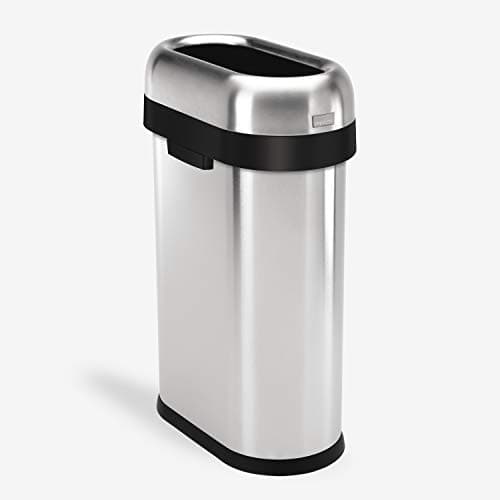
Best open-top
simplehuman 50L Slim Open Top Can
Heavy-gauge stainless with no lid and no pedal, for the spot where speed matters more than odor containment.
Price as of October 16, 2026. #ad How we make money
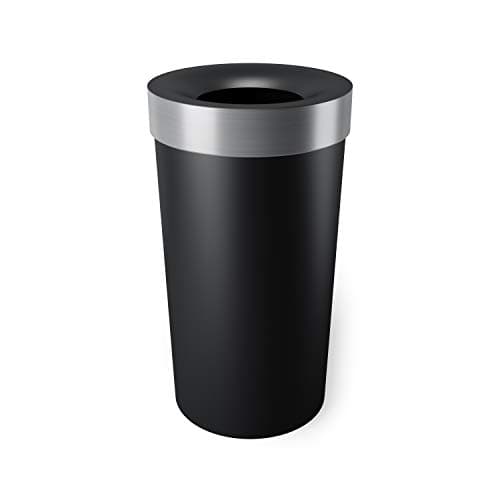
Best large open can
Umbra Vento Open Top Kitchen Trash Can, 16.5 Gallon
A 16.5-gallon open-top bin for a utility room, workshop or garage, where volume beats containment.
Price as of October 16, 2026. #ad How we make money
If the lid broke rather than you wanting it gone
That is a different question and the answer is usually not "live without it". Replacement lids exist for current models from most brands, and on many step cans the lid assembly carries the hinge and damper too - so buying the lid buys you a fresh mechanism.
The sequence is: find the model number on the sticker inside the base, check the manufacturer's own parts page, and only then consider a universal lid - which realistically exists for round outdoor cans and essentially nowhere else. Lid replacement, brand by brand, and for sensor cans touchless replacement parts.
How to run an open can well
- Use a bag with a drawstring and tie it. The bag is now your only containment, so closing it before it leaves the can does the job the lid was doing.
- Empty it on a schedule, not when it is full. Without a lid there is no warning smell building up inside - it is just in the room.
- Keep fruit and meat waste out of it. Freeze those until collection day, or keep a small lidded caddy beside it for scraps.
- Choose a can with a rim that hides the bag or a liner ring, since nothing else will.
- Wash the inside monthly. No lid means more dust and more airflow, and residue dries onto the walls faster. The cleaning routine.
Done that way an open can is not a compromise - in the right room it is simply the correct can, and it will outlast every step can you have owned.
Common questions
Is it OK to have a trash can without a lid?
Yes, anywhere food waste does not go - an office, a bathroom, a workshop, or as a recycling can beside a lidded one. In a kitchen with food scraps or a household with pets, a lid is doing real work.
Can you buy a 13 gallon trash can with no lid?
Yes. Proper open-top cans are sold at that size, including heavy-gauge commercial-grade steel ones, rather than you having to remove a lid from a step can.
Do open trash cans smell more?
The can does not produce more odor, but nothing holds it in - so the room smells instead of the can. With dry waste you will not notice. With anything organic you will, within a day.
Are lidless trash cans better for small spaces?
Often, yes, for a reason people miss: there is no lid-open clearance to allow for. A lidded can needs six to ten inches of swing above it, which an open can does not.
What is the best open-top trash can?
For a hallway or a prep area, a 50-liter heavy-gauge steel slim open can - narrow footprint, nothing to break, lift-off rim for fast bag changes. For a utility room, a 16.5-gallon plastic one is better value.
My trash can lid broke - should I just go without it?
Only if the can holds dry waste. Otherwise check the manufacturer's parts page against the model number inside the base first; on many step cans the lid assembly includes the hinge and damper, so replacing it renews the mechanism.
Sources
Every specification on this page traces to one of these, checked at the time of writing. Where a manufacturer does not publish a figure, the page says so rather than estimating it.
Read next
- Kitchen Trash CansStep cans, stainless, dual recycling and compost — plus the sizing nobody explains.
- Trash can lid replacement, brand by brandWhich brands sell replacement lids, how to identify the part, and when a new can is the cheaper answer.
- The best trash cans for an officeFive office cans, desk-side to break room - and why an open top is the right answer at a desk.
- The best bug-proof trash cansFive cans and traps picked on lid seal and interior cleanability - the two things that actually decide whether bugs breed in your bin.
- The best step trash cansSix pedal cans ranked on published cycle ratings and lid damping.
The author
Ryder M.
Owner and editor of Lid & Liner, published by Magoo Media Group. He started the site after getting tired of the same problem everyone has: every “best trash can” article covers ten products and none of them tells you whether a 13-gallon bag actually fits a 13-gallon can. Lid & Liner covers one category and tries to cover it completely.
Last reviewed October 10, 2026. Spotted an error? Tell us and we will correct it and note the correction.