Trash can pedal not working: how to fix it
A pedal that goes down without the lid coming up has five likely causes, and four of them are fixable in ten minutes with nothing but your hands. Work through them in this order.
By Ryder M. · Last reviewed October 6, 2026

Lid & Liner is reader-supported. If you buy through a link on this page we may earn a commission at no extra cost to you. It never changes which product we rank first — how we pick and how we make money.
The short answer
In most step cans the pedal has not broken - it has come disconnected. A pedal that travels freely and does nothing almost always means the rod between the pedal and the lid arm has popped out of its socket, and pushing it back in is a thirty-second repair. A pedal that will not travel at all is a jam. A pedal that travels and feels gritty is a worn linkage, and that is the one that means the can is done.
Nothing below needs tools beyond a flathead screwdriver, and none of it will void anything - these are the same checks a manufacturer's support line walks you through. Empty the can and tip it on its side on a towel before you start, so you can see the underside.
Find the cause in this order
Step 01
Check whether the bag is stopping the lid
Press the pedal and watch the lid rather than the pedal. If the lid lifts a few millimetres and stops, the liner is sitting proud of the rim and the lid is pressing on trash, not failing to open. Pull the bag down inside the rim and try again. This is the most common cause by a wide margin and it is not a fault.
Step 02
Look for the disconnected rod
Tip the can over. Nearly every step can works the same way: the pedal pivots on a pin, and a steel rod or plastic arm runs from the pedal up to a socket on the lid hinge. If the pedal moves but nothing else does, that rod has jumped its socket - look for a loose end rattling against the base. Push it back in until it clicks and stand the can up.
Step 03
Check the pedal pin and the base clips
If the rod is seated, feel whether the pedal itself is loose side-to-side. On cheaper cans the pedal rides on a moulded plastic pin that cracks, and a cracked pin lets the pedal twist instead of lifting. If the pin is intact, check the clips that hold the base plate on - a base that has sprung open lets the whole linkage sag out of alignment.
Step 04
Clear the jam
A pedal that will not move at all is jammed rather than broken. The usual culprits are a bag tail wrapped around the linkage, a dropped bottle cap wedged under the pedal, or a build-up of dried spill inside the base. Pick the debris out, then wash the base with a degreaser and let it dry fully before reassembling.
Step 05
Decide whether the linkage is worn out
If everything is connected, nothing is jammed, and the pedal still feels gritty or lifts the lid only partway, the linkage has worn. Plastic-on-plastic pivots develop slop, and slop means travel that no longer reaches the lid. There is no repair for this. At that point you are choosing between a replacement lid assembly, if the brand sells one, and a new can.
Why pedals fail, and which ones do not
A kitchen can gets opened somewhere between ten and thirty times a day. Over five years that is roughly fifty thousand cycles, every one of which passes through the pedal linkage. That is why the linkage, and not the lid or the body, is the part that decides how long the can lasts.
| Linkage type | Typical failure | Rough service life |
|---|---|---|
| Moulded plastic lever on a plastic pin | The pin cracks; the pedal twists | 1-3 years of daily use |
| Plastic lever with a steel rod | The rod jumps its socket | 3-5 years, usually repairable |
| Steel pedal on a steel linkage | Slop develops very slowly | Many years; often outlasts the finish |
| No pedal (touch lid) | No linkage to fail | Limited by the lid hinge instead |
The useful shortcut when shopping is to look for a published cycle rating. simplehuman states 150,000 steps for its step cans and EKO states over 200,000 for the Madison. Those are manufacturer figures rather than independent test results, but a brand willing to print a number is a brand that expects the part to survive it.
If the linkage is worn out and a spare part is not available, these are the three we would replace it with - two steel linkages with published cycle ratings, and one can with no pedal at all.
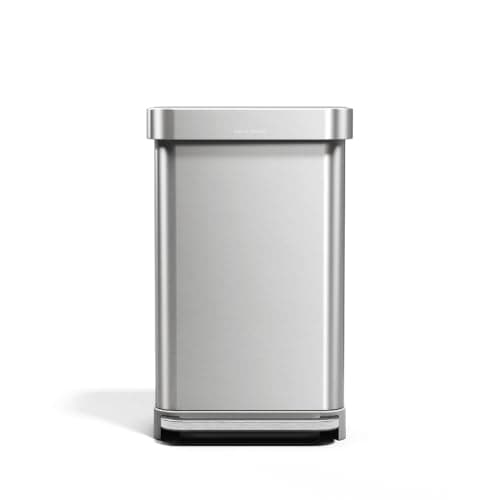
Best overall
simplehuman 45L Rectangular Step Can with Liner Pocket
The kitchen can that solves bag fit properly, with a pedal rated for 150,000 steps and a liner pocket that ends the hunt for the box under the sink.
Price as of October 16, 2026. #ad How we make money
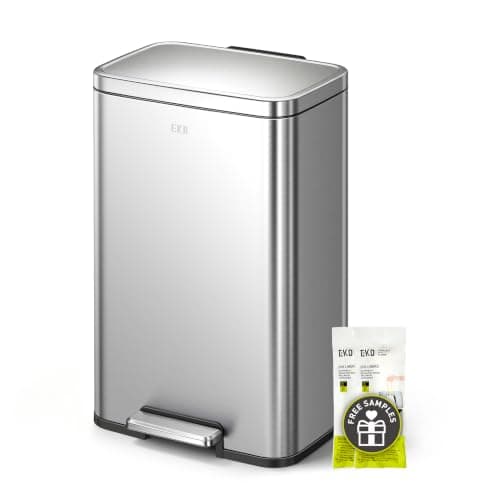
Best budget stainless
EKO Madison 13.2 Gallon Step Trash Can
The stainless step can that competes on the one spec that actually predicts lifespan — pedal cycles — without the premium-brand markup.
Price as of October 16, 2026. #ad How we make money
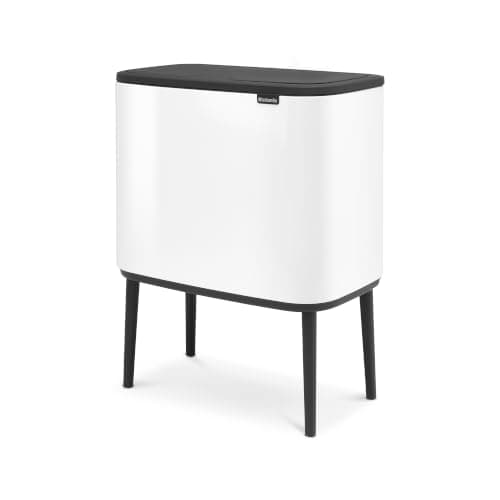
Best warranty
Brabantia Bo Touch Bin, 36 L
A touch-open bin with a ten-year guarantee and a removable inner bucket, built to sit flat against a wall.
Price as of October 16, 2026. #ad How we make money
The repairs that are worth doing
Reseating a jumped rod: free
Worth doing every time, and worth re-doing. Some cans jump the same socket repeatedly because the socket has widened; a wrap of electrical tape around the rod end takes up the slack and buys months.
Replacing a lid assembly: usually worth it
If the brand sells the part and the body is sound, this is the best value repair in the category. The body is the expensive part to manufacture and the part least likely to fail.
Gluing a cracked plastic pedal pin: not worth it
The pin carries the full load of every open. Adhesive repairs at that joint fail within weeks, and they fail with your foot on the pedal. If the pin is cracked, the can is finished.
Living with it as an open-top can: sometimes
Pulling the lid off entirely turns a broken step can into a working open can, which is genuinely fine in a garage or a utility room. In a kitchen it costs you the odor containment that the lid was doing. Odor control when the lid is gone.
If the can is a sensor can instead
None of the above applies to a motion-sensor can, because there is no linkage - the lid is driven by a small geared motor and the failure modes are electrical. A sensor lid that will not open is usually batteries, a dirty sensor window, or the lid being out of its home position. Touchless lid not opening covers that sequence, and batteries and power covers the half of those cases that are power-related.
If you are weighing a repair against switching types, the honest trade is that a step can has one part that wears out and a sensor can has several that can fail - but the sensor can has nothing you can break by standing on it. Step can versus touchless.
Common questions
Why is my trash can pedal not working?
In most cases the rod between the pedal and the lid arm has come out of its socket, so the pedal travels and the lid does not move. Tip the can on its side, find the loose rod end, and push it back into the socket.
How do you fix a trash can foot pedal?
Work in this order: pull the bag down inside the rim, reseat the connecting rod, check the pedal pin and base clips for cracks, clear any debris jamming the linkage, and only then conclude the linkage is worn.
Why does my trash can pedal go down but the lid stay shut?
Either the liner is sitting proud of the rim so the lid is pressing on trash, or the linkage between the pedal and the lid has disconnected. Those two causes account for the large majority of cases.
Can you replace a trash can pedal?
On some models, yes - several brands sell pedals, lids and inner buckets as spare parts for current cans. Find the model number on the sticker inside the base before you search, because pedals are not interchangeable between models.
Why is my trash can pedal stuck?
A pedal that will not travel is jammed, not broken. The usual causes are a bag tail wrapped around the linkage, a small object wedged under the pedal, or dried spill inside the base.
Is it worth repairing a trash can?
If the fix is reseating a rod or fitting a replacement lid, yes - the body is the expensive part and it rarely fails. If the plastic pedal pin is cracked, no: that joint carries every open and adhesive repairs do not hold.
Sources
Every specification on this page traces to one of these, checked at the time of writing. Where a manufacturer does not publish a figure, the page says so rather than estimating it.
Read next
- Kitchen Trash CansStep cans, stainless, dual recycling and compost — plus the sizing nobody explains.
- Trash can lid replacement, brand by brandWhich brands sell replacement lids, how to identify the part, and when a new can is the cheaper answer.
- The best step trash cansSix pedal cans ranked on published cycle ratings and lid damping.
- The best soft-close trash cansFive damped lids compared on the mechanism that does the damping - and what it costs you.
- Touchless trash can lid not openingSix checks in order of cost, and an honest point at which to stop repairing.
- Touchless vs step trash cansPedal or sensor, compared on failure mode, running cost, speed and noise - with the verdict by kitchen.
The author
Ryder M.
Owner and editor of Lid & Liner, published by Magoo Media Group. He started the site after getting tired of the same problem everyone has: every “best trash can” article covers ten products and none of them tells you whether a 13-gallon bag actually fits a 13-gallon can. Lid & Liner covers one category and tries to cover it completely.
Last reviewed October 6, 2026. Spotted an error? Tell us and we will correct it and note the correction.