How to keep dogs out of the trash
A dog does not defeat a trash can by being clever. It defeats it by being heavier than the lid. Work through these in order and you will usually stop it without buying anything.
By Ryder M. · Last reviewed October 10, 2026
Lid & Liner is reader-supported. If you buy through a link on this page we may earn a commission at no extra cost to you. It never changes which product we rank first — how we pick and how we make money.
The short answer
Move the can behind a door, and if you cannot, buy a can whose lid locks mechanically to the body. Everything else is a variation on those two. A dog gets into a trash can by nosing the lid until it lifts or by knocking the can over so the lid falls off - so the fix is either removing the can from the room or making the lid a part the dog cannot separate from the body. Weighting the can, taping the lid and scolding the dog all fail, for reasons worth understanding.
The reason this is worth doing properly rather than improvising is that the stakes are higher than a mess on the floor. Cooked bones, corn cobs, grease, chocolate, onion skins, coffee grounds and discarded medication are all in a normal kitchen can, and several of them are genuine veterinary emergencies.
Seven fixes, in the order worth trying
Step 01
Put the can inside a cabinet
This is the only fix that is not a contest between the dog and a mechanism. A can in a cabinet, under the sink or behind a pantry door is simply unavailable. If you have the cabinet, stop here - nothing below is as reliable.
Step 02
Move it to a room the dog cannot enter
A utility room, a garage or a pantry with the door shut. Second-best for the same reason: it removes the contest rather than winning it. The cost is that you will walk further with every scraping of a plate, and a can you resent using ends up back in the kitchen.
Step 03
Fit a can with a mechanical lid lock
Not a heavy lid - a lock. A slide catch or a lid that latches to the body cannot be nosed open regardless of how much the dog weighs. Expect to use it every single time; the first week you will forget, and the dog only needs one night.
Step 04
Stop the can tipping over
Half of all raids are the can going over, not the lid lifting. Put it in a corner, against a cabinet run, or on a non-skid mat. A can wedged on three sides cannot be dragged into open floor where a dog can work on it.
Step 05
Change what goes in the can
The raid is about smell, and the smell is specific. Meat trays, bones, grease-soaked paper towel and cheese wrappers are what bring the dog across the kitchen. Freeze them until collection day, or put them in an outdoor can - the kitchen can stops being interesting.
Step 06
Empty it more often, especially at night
Most raids happen when nobody is in the room, which in practice means overnight. An empty can at bedtime removes the opportunity entirely, and it is free.
Step 07
Make the approach less rewarding, not scary
Feed the dog before you cook, leave a filled chew out during meal prep, and keep the can away from where the dog settles. The goal is competition for the behaviour, not punishment for it - punishment arrives after the fact and teaches a dog to raid when you are out rather than not to raid.
Nothing in that list requires a new can until step three, and most households solve it at step one or step four. If you are at step three and shopping, the cans built for this is the ranked list.
Why weight does not work
The most common advice on this subject is to buy a heavier can, and it is wrong in a specific and useful way. A dog does not need to lift the can. It needs to lift the lid, which on almost every pedal can is a light panel on a loose hinge, and it has a nose and a jaw with far more force available than that panel resists.
- A stainless steel body does nothing about a lid that pivots freely. It just means the body is dented rather than knocked over.
- Bricks in the bottom stop the can tipping, which is useful - but a can that stays upright with the lid nosed open is still a raided can.
- A damped lid is not a locked lid. Soft-close resists speed, not force. It will settle gently while a dog holds it open.
- A lid lock is a different category of thing. It is a mechanical connection between lid and body, and it is the only feature on a kitchen can that reliably stops a determined dog.
The two mechanical locks worth owning: a premium plastic-bodied can with a slide lock, and the cheapest can whose lid genuinely latches to the base.
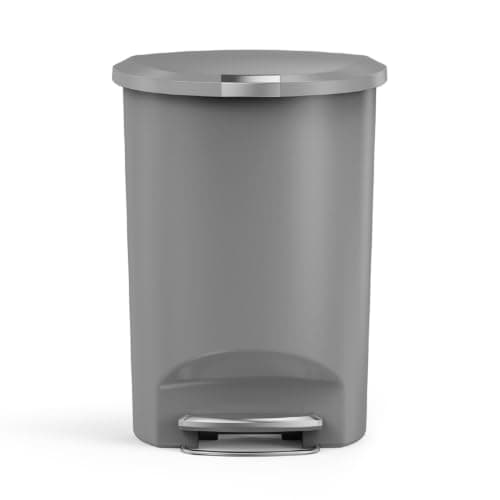
Best for pets
simplehuman 50L Semi-Round Step Can with Slide Lock
The same semi-round shape with a slide lock that physically holds the lid shut against a determined dog.
$55.00 · 9% off · Price as of October 16, 2026. #ad How we make money
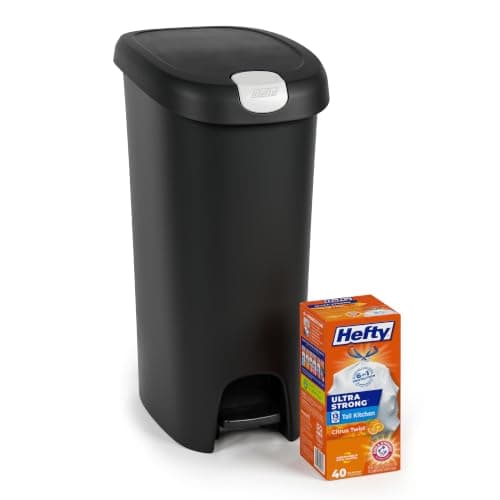
Best cheap locking can
Hefty 12 Gallon Step Trash Can with Lockable Lid
A plastic 12-gallon step can whose lid actually locks to the body — the cheapest honest answer to a dog or a toddler in the trash.
Price as of October 16, 2026. #ad How we make money
If the dog raids the outdoor can instead
A different problem with a different answer, because outdoors the can is unattended for far longer and the dog has company - raccoons, rats and neighbourhood dogs are all working on the same container.
The fixes that work outside are a cart with an attached, clamping lid, a strap or lock over the top, and keeping the cart in an enclosure until collection morning. We cover that properly in trash cans with locking lids, lid locks and straps and outdoor enclosures.
If the problem is specifically the dog's own waste rather than kitchen trash, that is its own container question: the best trash cans for dog poop.
What to do if the dog has already eaten something
We are not veterinarians and this is not veterinary advice. What we will say is that the useful thing to do before anything happens is practical: know what your can contains, and know your vet's out-of-hours number.
- Work out what is missing. The bag contents tell you what the dog actually got, and that is the first question any vet will ask.
- Call your vet or an emergency line rather than waiting to see. Cooked bones, corn cobs, grease, chocolate, grapes, onion and discarded medication are the items that turn a mess into an emergency.
- Do not try to make the dog sick unless a vet tells you to. With sharp objects and some substances it makes the outcome worse.
- Then fix the can, properly, today - a dog that has succeeded once will try again tonight.
Common questions
How do I stop my dog getting into the trash?
Put the can in a cabinet or behind a door if you can. If you cannot, buy a can whose lid mechanically locks to the body, wedge it so it cannot tip, and stop putting meat trays and bones in it.
Will a heavy trash can stop a dog?
No. The dog lifts the lid, not the can. Weight stops the can tipping over, which is worth having, but a heavy can with a freely pivoting lid is still an open can to a determined dog.
Do dog-proof trash cans work?
The ones with a mechanical lid lock do, because the lid and body become one piece. Cans marketed as pet-proof purely on the weight of the lid or the body do not.
Should I spray something on the trash can to deter my dog?
We would not. Bitter sprays and pepper teach some dogs to avoid the kitchen rather than the can, and others simply switch to tipping it over. Removing access works; making the can unpleasant usually just moves the behaviour.
Why does my dog only raid the trash when I am out?
Because that is when there is no competition for the behaviour and no interruption. It is not spite - it is the only window in which the raid reliably succeeds. That is also why punishing it afterwards does not work.
What is the cheapest way to dog-proof a trash can?
Move it behind a door, which is free. If that is not possible, a plastic step can with a lid that locks to the base is the least expensive product that actually holds, and it takes a standard 13-gallon liner.
Sources
Every specification on this page traces to one of these, checked at the time of writing. Where a manufacturer does not publish a figure, the page says so rather than estimating it.
Read next
- Kitchen Trash CansStep cans, stainless, dual recycling and compost — plus the sizing nobody explains.
- The best dog-proof trash cansFive cans ranked on lid locks and cabinet mounting, because weight alone never stops a dog.
- The best trash cans with locking lidsFive cans with the latch built in - ranked by what the lock actually resists, from wind to bears.
- The best under-sink pull-out trash cansSix pull-outs compared on slides, frames and the openings they actually need.
- The best trash cans for dog poopFive options, including the digester that removes the storage problem entirely.
The author
Ryder M.
Owner and editor of Lid & Liner, published by Magoo Media Group. He started the site after getting tired of the same problem everyone has: every “best trash can” article covers ten products and none of them tells you whether a 13-gallon bag actually fits a 13-gallon can. Lid & Liner covers one category and tries to cover it completely.
Last reviewed October 10, 2026. Spotted an error? Tell us and we will correct it and note the correction.