TOWNEW S2000 review
It does the thing it says: a heated bar welds the liner shut and the next one is already waiting. Two things the listing will not tell you decide whether that is worth it to you.
By Ryder M. · Last reviewed October 27, 2026
Lid & Liner is reader-supported. If you buy through a link on this page we may earn a commission at no extra cost to you. It never changes which product we rank first — how we pick and how we make money.
The verdict in one paragraph
The S2000 is the best-built thing in a small category and the only one whose maker will put real numbers on paper. Sensor lid, a thermal head that welds the liner shut on command, a ring that feeds the next bag into place, and a published spec sheet: 16.0 liters, 305 x 260 x 390 mm, a 2000 mAh cell TOWNEW rates at up to 20 days of standby. Buy it for a bathroom, a nursery or a sickroom, where a bag sealed before it crosses the house is worth real money. Do not buy it as a kitchen can, and do not buy it before you have worked out what the rings cost you per year.
| # | Product | Best for | Price |
|---|---|---|---|
| 01 | 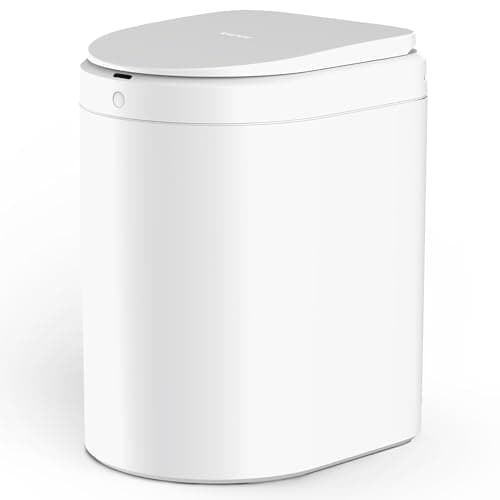 TOWNEW S2000 Smart Trash Can with Self-Sealing Bag ClosureThe current TOWNEW flagship: a motion-sensor lid, a thermal head that welds the bag shut, and a ring that feeds the next liner into place on its own. | Best overall | $99.00 · View on Amazon Price as of October 27, 2026. #ad How we make money |
If you have not settled on the category yet, the best smart trash cans ranks this against the five alternatives and explains why none of them connect to an app. This page is for the reader who has decided they want a self-sealing can and wants to know what owning this one is like.
What it actually does
The mechanism is worth describing precisely, because "smart trash can" covers two different products and only one of them is this.
- The lid opens on a motion sensor, the same infrared arrangement as any touchless can.
- The liner is not a bag. It is a ring of continuous polyethylene film - TOWNEW calls the S2000's an R16 ring - seated in the top of the can and fed downward as it is used.
- When the can is full you press the seal button. A heated bar - TOWNEW's "flexible thermal sealing head", which it says adapts to bag thickness and pressure - closes across the film and welds it shut.
- You lift out a sealed parcel, and the head welds the film again below the cut so a fresh liner is already open and waiting.
- You never knot a bag, and you never fit a new one. That is the entire value proposition, and it does deliver it.
In the box: the unit, one R16 ring pre-installed, a charging cable and a manual. No wall adapter, which is standard for this class and worth knowing if you do not have a spare USB brick.
The capacity problem
This is the first of the two things the listing will not tell you, and it is the one most likely to disappoint somebody.
The Amazon listing title for the S2000 says 5.5 gallons. TOWNEW's own specification page for the same model says 16.0 liters. Sixteen liters is 4.2 US gallons. That is a gap of about a third, and it is not a rounding error. We checked the same brand's T Air Lite as a control: TOWNEW specifies it at 16.6 liters and sells it as 4.4 gallons, which converts correctly. So this is one listing out of step with the spec sheet rather than a company that cannot do arithmetic.
The footprint is genuinely compact for what it is: 305 mm wide, 260 mm deep, 390 mm tall, which is 12.0 by 10.2 by 15.4 inches. That is a can that fits beside a toilet or under a desk, and the dimensions are published, which is more than most of this category manages. Measure the lid swing above it as well - a sensor lid needs clearance it does not advertise.
The running cost, done properly
This is the second thing, and it is the one that should decide your purchase. The S2000 does not take trash bags. It takes R16 refill rings, sold by TOWNEW in three-packs and eight-packs, and there is no supermarket substitute.
Here is the honest complication: TOWNEW publishes a bags-per-ring figure for its T1-series ring - up to 150 bags from a six-pack, which it calls about six months - but we could not find an equivalent published figure for the R16 ring used by the S2000. So you cannot calculate a cost per bag from the box. You have to buy a pack, use it, and find out. We are not going to estimate a number we cannot verify.
What we can say with confidence is the direction. On pure cost per liner, a self-sealing can loses to a box of 8-gallon drawstring bags by a wide margin, and that is true of every brand in this category, not just this one. If you are hoping the convenience pays for itself, it does not. The case for the S2000 has to be made on what the sealing does for you, not on what it saves.
- Buy rings with the can. It ships with exactly one ring installed. The eight-pack is the sensible standing order.
- Do not buy the wrong ring. The R16 fits the S2000 and its variants. TOWNEW's T1-series ring - the one with the published 150-bag figure - does not fit this can, and no Airdeer ring fits either.
- Third-party rings exist at well under half the official price. Fit is reported rather than guaranteed, and a ring that does not seat correctly will jam a sealing head, so the saving carries a real risk on this particular part.
- Measure your own consumption for a month before you commit to a bulk order. A bathroom bin and an office bin burn film at completely different rates.
Power and the battery question
TOWNEW rates the S2000's 2000 mAh cell at up to 20 days of standby. That is a manufacturer figure on their own testing, and it is worth reading as a ceiling rather than an average - a can in a busy bathroom is not on standby, it is cycling a sensor and firing a heating element.
Two practical notes. First, a heated sealing bar is a far bigger draw than an infrared lid motor, so this will want charging considerably more often than a battery-powered sensor can wants new cells. Plan for a cable within reach. Second - and this is the structural weakness of the whole category - the battery is not user-replaceable and TOWNEW does not sell it as a part. A rechargeable cell has a finite number of cycles in it, which makes this a five-year appliance rather than a ten-year can.
Interestingly the cheaper T Air Lite is rated longer, at up to 30 days standby, which is what you would expect from a simpler mechanism with a push-button seal instead of a sensor lid. If battery anxiety is your main worry, that is the model to look at. For battery behavior generally across sensor cans, touchless trash can batteries and power covers the ground.
Where it genuinely earns its price
We are skeptical about a lot of this category, so it is worth being equally clear about where this can is the right answer rather than an indulgence.
- A bathroom. A bag welded shut before it leaves the room is the single best argument for the product, and it is the one the marketing underplays in favor of the word "smart".
- A nursery. Compared fairly - against a diaper pail with a proprietary cassette rather than against a box of bags - the running cost looks much more reasonable, and the sealing is at least as good.
- A sickroom, or a household where handling waste is physically difficult. Not having to gather, knot and lift a liner is an accessibility feature. This is the use we would defend hardest, and it is the one nobody markets.
- A small office or a studio flat where the bin shares a room with you and the walk to a dumpster is long.
And the uses we would talk you out of: a family kitchen, because 16 liters will not keep up and the per-liner cost at that volume is punishing; a garage or utility room, because nothing there needs sealing and a plain can is tougher; and buying it to fix a smell, because a sealed bag does nothing about the bucket underneath it. That is a cleaning problem, and it is free to fix.
What to buy instead, depending on your reason
If the attraction is hands-free and the sealing is incidental, buy an ordinary sensor can - you will get far more capacity for less money and you will not be on a film subscription. The best touchless trash cans ranks that field. If the attraction is the sealing but the price is not, the TOWNEW T Air Lite does the same weld with a push button instead of a sensor, at a published 16.6 liters and a longer battery rating. And if you need this at genuine kitchen capacity, the only option is the Airdeer L2 at a listed 8 gallons - with the caveat that Airdeer publishes no spec sheet at all, which after reading this page you will understand why we weigh heavily.
The can and the consumable it needs. Buy them together - the S2000 ships with exactly one ring installed.
Best overall
TOWNEW S2000 Smart Trash Can with Self-Sealing Bag Closure
The current TOWNEW flagship: a motion-sensor lid, a thermal head that welds the bag shut, and a ring that feeds the next liner into place on its own.
Price as of October 27, 2026. #ad How we make money
The S2000's consumable
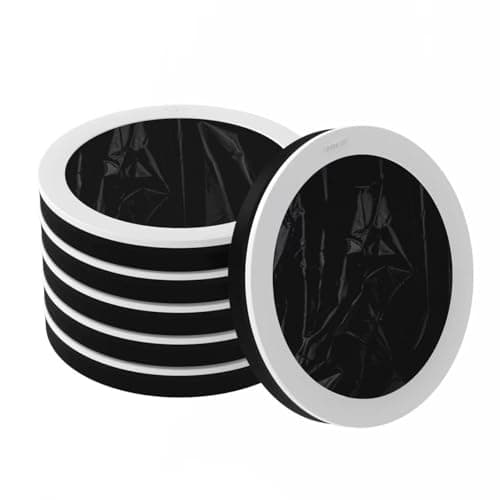
TOWNEW S2000 Official Refill Rings, 8 Pack
The official eight-pack of R16-type rings for the S2000 - the consumable you are committing to when you buy that can.
Price as of October 27, 2026. #ad How we make money
The comparison we would most want you to make before ordering: price a year of R16 rings against a year of 8-gallon drawstring liners, look at the difference, and decide whether a sealed bag is worth that to you. For a nursery or a sickroom the answer is often yes. For a spare bathroom it is usually no, and there is no shame in that.
Common questions
How big is the TOWNEW S2000 really?
TOWNEW's own specification page says 16.0 liters, which is 4.2 US gallons. The Amazon listing title says 5.5 gallons. Plan around the 16-liter figure - this is a large bathroom bin, not a kitchen can.
What refill rings does the TOWNEW S2000 use?
R16 rings, sold by TOWNEW in three-packs and eight-packs. The T1-series rings used by the T1S, T Air X and T Air Lite do not fit it, and no Airdeer ring fits it either.
How many bags do you get from an S2000 refill ring?
TOWNEW does not publish a bags-per-ring figure for the R16 the way it does for its T1-series ring, so there is no honest way to state one. Buy a pack, measure your own consumption over a month, and work from that.
How long does the TOWNEW S2000 battery last?
TOWNEW rates the 2000 mAh cell at up to 20 days of standby - a manufacturer figure, and a ceiling. A heated sealing bar draws far more than a lid motor, so a can in regular use will want charging considerably more often than that.
Is the TOWNEW S2000 app-connected?
No. Nothing in this category is. "Smart" here means self-sealing and self-changing - there is no app, no fill-level reporting and no smart-home integration on any mainstream household trash can we can find.
Is the TOWNEW S2000 worth it?
In a bathroom, a nursery or a sickroom, often yes - a bag welded shut before it leaves the room is a real benefit. In a kitchen, no: 16 liters will not keep up and the cost per liner at that volume is punishing against an ordinary box of bags.
Can you use normal trash bags in a TOWNEW?
No. The can feeds a continuous film ring rather than taking a pre-made bag, so the proprietary ring is the only liner it accepts. That consumable is the main ongoing cost of owning one.
Sources
Every specification on this page traces to one of these, checked at the time of writing. Where a manufacturer does not publish a figure, the page says so rather than estimating it.
- TOWNEW - S2000 specifications (16.0 L capacity, 305 x 260 x 390 mm, 2000 mAh cell up to 20 days standby, R16 refill ring, box contents)
- TOWNEW - T Air Lite specifications (16.6 L, up to 30 days standby, up to 25 bags per ring) - used as the conversion control
- Amazon - TOWNEW S2000 retail listing (the 5.5 gallon figure quoted on this page)
- Amazon - TOWNEW official refill rings for T1S / T Air X / T Air Lite (the published 150-bag figure, for contrast with the R16)
Read next
- The best smart trash cansSix self-sealing cans compared on real capacity, published specs and the refill-ring cost nobody puts on the box.
- The best touchless trash cans of 2026Seven sensor cans compared on sensor behavior, battery life and warranty.
- The best 8 gallon trash bagsSeven 8-gallon bags compared on measured width, published gauge, closure type and real cost per bag.
- Trash can vs diaper pailWhat a diaper pail actually buys you over a sealed kitchen can, and when it is not worth it.
- Touchless trash can batteries and powerWhat each brand takes, how long it lasts, and when mains power pays off.
- Affiliate disclosureHow the site is funded and why commission never sets a ranking.
The author
Ryder M.
Owner and editor of Lid & Liner, published by Magoo Media Group. He started the site after getting tired of the same problem everyone has: every “best trash can” article covers ten products and none of them tells you whether a 13-gallon bag actually fits a 13-gallon can. Lid & Liner covers one category and tries to cover it completely.
Last reviewed October 27, 2026. Spotted an error? Tell us and we will correct it and note the correction.