simplehuman trash can replacement parts
simplehuman runs the best parts operation in the category - a support page per model, with pedals, lids and air dampers listed by part number. The catch is that you have to find your model first, and nothing on the can tells you its name.
By Ryder M. · Last reviewed November 3, 2026
Lid & Liner is reader-supported. If you buy through a link on this page we may earn a commission at no extra cost to you. It never changes which product we rank first — how we pick and how we make money.
The short answer
simplehuman sells replacement parts directly, organized by model rather than by part. Each can has its own product-support collection on simplehuman.com listing the parts that fit it - pedal, lid or trim-ring assembly, air damper, hinge hardware - each with a PD part number and a price. That is a real repair path, and almost nothing else in this category has one. Two things to know before you start: the part numbers are model-specific and do not carry across the range, and the single most-replaced item on a simplehuman can is not a part at all. It is the liner, and it is sold by a code letter printed on a tag under the lid.
How the parts system is organized
There is no single parts catalog to browse. Instead, each can has a product-support collection - a page per model with that model's replacement parts, its troubleshooting notes and a link to the warranty claim form. You reach it by searching the model name plus "product support", and once you are on the right one the parts listed there are the parts that fit.
The parts are numbered with a PD prefix and the numbers are allocated per model, which is why two cans that look identical from across the kitchen take different pedals. On the 45-liter rectangular liner-pocket step can the pedal is PD6246 and the lid and trim ring come as one assembly, PD6247 in black or PD6248 in grey. On the 30-liter rectangular plastic-lid step can the pedal is PD0354 and the lid is a separate part, PD0290. Nothing about those numbers is guessable, and ordering the wrong one is a return rather than a repair.
| Part type | What it is | Typical price bracket | Notes |
|---|---|---|---|
| Pedal | The foot lever and its linkage arm | Around $25-$40 | The most-ordered mechanical part; varies most between models |
| Lid, or lid and trim ring assembly | On newer cans the lid and trim ring ship as one unit | Around $30-$35 | Sold by color - black and grey are separate part numbers |
| Air damper | The cylinder that makes the lid close slowly | Around $10-$15 | What to replace when the lid starts slamming |
| Hinge hardware | Hinge pins, leaf springs, hinge blocks | Low single digits to low double digits | Cheapest parts in the system; often the actual fault |
A note on region: simplehuman's UK site runs the same system with different part numbers and prices in pounds. If a search drops you on a .co.uk support page, the troubleshooting applies but the part number may not. Check you are on the US site before you order.
Try this before you order a part
Three of the most common complaints are not broken parts at all, and simplehuman's own support pages say so. Work through these first - two of them cost nothing and take a minute.
Step 01
Squeaking lid
Open the lid from the trim portion and lubricate the steel chrome rod at the rear of the unit with WD-40 or a similar lubricant. A squeak is a dry pivot, not a failing damper, and lubricating it is the fix simplehuman recommends on its own support pages.
Step 02
Lid stays open, or slams shut, after a liner change
Separate the lid and the trim by hand, then push the trim down manually. A slight noise while you do this is normal and will not harm the can. This is the single most common support question on the step cans and it is a re-seating issue rather than a broken damper.
Step 03
Lid still slams after re-seating
Now it is the air damper. That is a cheap, model-specific part in the low double digits, and replacing it is the difference between a can you keep and a can you replace. Order it by the part number on your model's support page.
Step 04
Pedal feels dead or does not lift the lid
Look at the linkage arm inside the back of the can before ordering. If the arm has come off its pin, re-seat it. If the pedal or the arm is cracked, the pedal is the part and it is the most expensive of the mechanical parts.
Step 05
Odor you blame on the can
Clean it before you buy anything. simplehuman's guidance for its plastic cans is a diluted household bleach and water solution, or a baking soda solution. A pod or a filter on a dirty can is perfume over a problem - the full method is in how to clean a trash can.
The liner codes, which is what most people are actually here for
The part people replace most on a simplehuman can is the bag. The company sells liners cut to each can rather than to a nominal gallon figure, and it identifies them with a single code letter - 22 of them, from A through Z with several letters skipped. The code is on the ID tag under the lid. It is not derivable from the capacity, the shape or the model name, and this is the single most common ordering mistake in the brand.
| Code | Stated fit | Typical can |
|---|---|---|
| G | 30 liter / 8 gallon | Under-counter pull-out buckets |
| J | 38-45 liter / 10-12 gallon | Mid-size butterfly and step cans |
| K | 30-45 liter / 8-12 gallon | Semi-round and round 40-45 L bodies |
| M | 40-45 liter / 11-12 gallon | 45 L rectangular step cans |
| N | 45-50 liter / 12-13 gallon | The true 13-gallon bodies |
| Q | 50-65 liter / 13-17 gallon | Large rectangular and recycler cans |
| R | 10 liter / 2.6 gallon | Compact bathroom and vanity cans |
One honest wrinkle worth knowing: simplehuman's own listings are not perfectly consistent about these ranges. The Code K 100-count box states 30-45 liters while the 60-count dispenser pack states 35-45, and Code J appears as both 30-45 and 38-45 depending on which box you are reading. The overlap between J, K and M is real and it is why the tag beats the arithmetic every time.
The three largest common codes, which between them cover most full-size kitchen cans.

Best fitted liner
simplehuman Code Q Custom Fit Liners, Odorsorb
The liner that actually fits a 50-65 liter simplehuman can, with carbon worked into the film instead of a fragrance.
Price as of November 14, 2026. #ad How we make money
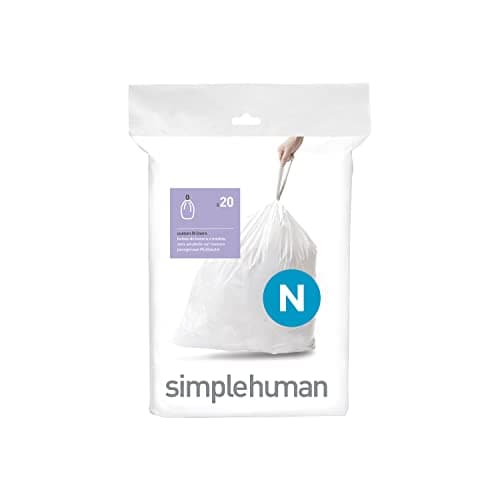
Best for 45-50 L cans
simplehuman Code N Custom Fit Liners, Dispenser Packs, 20 Count
Code N, stated by simplehuman at 45-50 liters or 12-13 gallons - the code for the cans people think of as 13-gallon.
Price as of November 14, 2026. #ad How we make money

Best for 40-45 L cans
simplehuman Code M Custom Fit Liners, 100 Count
Code M, stated by simplehuman at 40-45 liters or 11-12 gallons - the narrowest fit window of the common codes.
Price as of November 14, 2026. #ad How we make money
The mid-size and under-counter codes. Check the tag before you buy any of them.

Best for 30-45 L cans
simplehuman Code K Custom Fit Liners, 100 Count
Code K, stated by simplehuman at 30-45 liters on the 100-count box - one of the two most common codes in American kitchens.
Price as of November 14, 2026. #ad How we make money
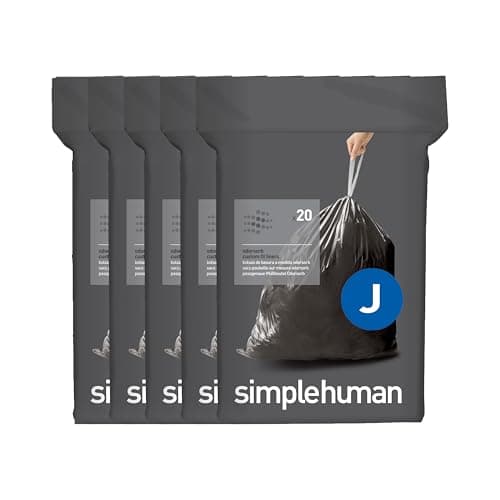
Best for 30-45 L cans
simplehuman Code J Custom Fit Liners, Odorsorb
The Code J liner, sized for 30-45 liter cans — one of the most common simplehuman sizes in American kitchens.
Price as of November 14, 2026. #ad How we make money

Best for under-counter cans
simplehuman Code G Custom Fit Drawstring Trash Bags
The liner sized for simplehuman's under-counter pull-out buckets, where overhang is not just untidy but jams the drawer.
$27.99 · 7% off · Price as of November 14, 2026. #ad How we make money
Third-party liners, and whether they are a mistake
The liner bill is the running cost nobody factors into the purchase. At one change every three or four days, a household goes through roughly 100 liners a year per can, indefinitely, and branded coded liners are several times the price per bag of a supermarket drawstring. That arithmetic is the real argument in is simplehuman worth it.
The thing you are paying for is a shape, and a shape is not proprietary. Plasticplace and Reli. both sell liners cut to simplehuman codes at a fraction of the cost per bag, and the Plasticplace Code J listing does something simplehuman does not: it prints the actual flat dimensions, 21 by 28 inches. If the refill price is what has you considering going back to ill-fitting supermarket bags, try a compatible liner before you give up the fit entirely.
The two third-party coded liners worth trying, for the two most common mid-size codes.

Best third-party Code J
Plasticplace Custom Fit Trash Bags Compatible with simplehuman Code J, 50 Count
A third-party Code J liner at a fraction of the cost per bag, which is the honest answer for anyone who likes the fit and resents the refill price.
Price as of November 14, 2026. #ad How we make money
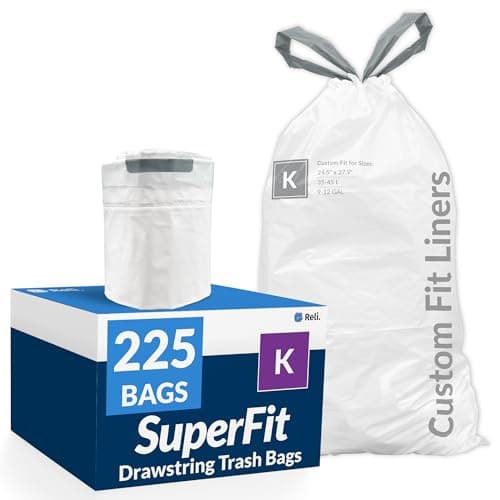
Best third-party bulk
Reli. Code K Trash Bags Compatible with simplehuman Code K, 225 Count
The bulk version of the same idea: 225 Code K liners, stated to the same 35-45 liter fit as the branded bag.
Price as of November 14, 2026. #ad How we make money
The caveat is real but narrow: simplehuman's warranty terms exclude damage attributed to non-simplehuman parts and accessories. On a step can, where the liner touches nothing mechanical, that is close to theoretical. On a sensor can, where a liner that bunches can foul the lid mechanism, it is worth thinking about. Our standing position is to tell you about the cheaper option and let you weigh it - how we pick explains why.
The warranty, and what it will not cover
simplehuman's warranty page does not publish a single length for trash cans. It states that the period varies by model and by the retailer the can was bought from, with a separate one-year term for commercial use. So the honest answer to "how long is my simplehuman can covered for" is: check the listing you bought it from, and keep the receipt.
- Covered: defects in materials or workmanship under normal household use, with the can cared for per its instructions. simplehuman may send parts, send a replacement, or issue merchandise credit at the original price.
- Not covered: normal wear and tear, including dents and scratches. This is the exclusion that catches people - a pedal that has worn out over years of use is wear, not a defect.
- Not covered: misuse, improper cleaning, alterations, and damage attributed to non-simplehuman parts or accessories.
- Not covered: hard-water scale, prolonged dampness, and extreme heat, cold or outdoor exposure. Relevant if the can lives in a garage.
- Not covered: purchases from unauthorized sellers, items bought as-is, specially discounted items, and third-party refurbished cans.
- Not covered: contents and batteries.
To file, you need a dated proof of purchase, the serial number - usually on the back or bottom of the can - plus the SKU, your contact details, a description, and up to three photos. simplehuman asks that at least one photo shows a handwritten note with your email address and the date beside the fault without covering it, which is an anti-fraud step rather than a formality. Skip it and the claim stalls.
When the part you need is not sold
The parts system covers the things that wear: pedals, lids, dampers, hinge hardware, liner rims. It does not cover the body, and on the sensor cans it does not offer a sensor module or a motor as a user-replaceable part. If the shell is dented or the electronics in a sensor lid have failed outside warranty, the can is the part.
- Dented or scratched body. Cosmetic, explicitly excluded from the warranty, and not sold as a part. Live with it or replace the can.
- Sensor can that will not open. Work through touchless lid not opening first - most of these are power or sensor-obstruction faults rather than dead electronics.
- Pedal on an older model with no support page. Discontinued models drop off the site. Contact support with the serial number before assuming nothing exists; parts for a model often outlive its page.
- Inner bucket. Sold for some models and not others. If yours is not listed, a generic bucket of the right height usually works, since nothing about it is mechanical.
For what it is worth, a parts operation this detailed is itself a reason the brand costs what it does, and it compares well with the rest of the field. Ninestars runs a real parts store with its own gaps, Joseph Joseph sells liners and filters by code, Glad sells no can parts at all, and the Amazon Basics line has no parts path whatsoever. A can you can repair in year four is a different purchase from one you cannot.
The liners, bought cheaper
Custom-fit liners are the part you buy most often. simplehuman liner alternatives covers the third-party bags cut to the same codes, and what you give up by switching.
Common questions
Does simplehuman sell replacement lids?
Yes, by model. On newer cans the lid and trim ring ship as a single assembly with its own part number and a color option - PD6247 in black and PD6248 in grey on the 45-liter liner-pocket step can, for example - and on others the lid is a separate part. Find your model's product-support page for the right number.
How do I find my simplehuman model number?
The model name is on the box, on your original order confirmation, and on the ID label on the back or underside of the can alongside the serial number. simplehuman organizes parts by model name rather than by capacity, so you need it before you can order anything.
Where is the liner code on a simplehuman can?
On the ID tag under the lid. It is a single letter and it cannot be worked out from the can's capacity or shape - the fit ranges for codes J, K and M overlap, so the tag is the only authority.
How much is a replacement simplehuman pedal?
Around $25 to $40 depending on the model, read from simplehuman's own US support pages on November 3, 2026. Pricing moves, so check the live page for your model before planning a repair.
Why does my simplehuman lid slam shut?
Usually because the lid and trim have come out of alignment after a liner change - separate them by hand and push the trim down, which is simplehuman's own fix. If it still slams, the air damper has failed, and that is a cheap model-specific part.
How long is the simplehuman warranty?
simplehuman does not publish a single figure. Its warranty page states the period varies by model and by the retailer you bought from, with a separate one-year term for commercial use. Check the listing you bought from and keep a dated proof of purchase.
Can I use non-simplehuman liners?
Yes, and Plasticplace and Reli. both sell liners cut to simplehuman codes for much less per bag. The warranty excludes damage attributed to non-simplehuman accessories, which matters more on a sensor can than on a step can where the liner touches nothing mechanical.
Sources
Every specification on this page traces to one of these, checked at the time of writing. Where a manufacturer does not publish a figure, the page says so rather than estimating it.
- simplehuman - 45L rectangular liner pocket step can product support (part numbers PD6246, PD6247, PD6248, PD6285 and troubleshooting), fetched 2026-11-03
- simplehuman - 30L rectangular step can with plastic lid product support (part numbers PD0354, PD0290, PD0268R)
- simplehuman - warranty terms, exclusions and claim requirements, fetched 2026-11-03
- simplehuman - custom fit liners collection and code finder (22 liner codes; code is on the ID tag under the lid)
- Amazon - simplehuman Code K 100 count custom fit liners (stated 30-45 liter / 8-12 gallon, 50% post-consumer recycled)
- Amazon - Plasticplace custom fit liners compatible with simplehuman Code J (published 21" x 28" flat size)
Read next
- The best simplehuman trash cansSix simplehuman cans ranked by the kitchen each belongs in, plus the liner code that sets the running cost.
- Is simplehuman worth it?The cost-per-year structure, including the liner cost nobody counts.
- Ninestars trash can replacement partsWhat Ninestars actually stocks, what the lid warranty excludes, and the fix when your model is not in the catalog.
- Trash can lid replacement, brand by brandWhich brands sell replacement lids, how to identify the part, and when a new can is the cheaper answer.
- Trash can pedal not working: how to fix itFive causes of a dead step pedal, in the order to check them - and the one that means the can is finished.
- Affiliate disclosureHow the site is funded and why commission never sets a ranking.
The author
Ryder M.
Owner and editor of Lid & Liner, published by Magoo Media Group. He started the site after getting tired of the same problem everyone has: every “best trash can” article covers ten products and none of them tells you whether a 13-gallon bag actually fits a 13-gallon can. Lid & Liner covers one category and tries to cover it completely.
Last reviewed November 3, 2026. Spotted an error? Tell us and we will correct it and note the correction.